
Granite Marble White

White marble offers unmatched classic elegance, but white granite is the objectively more practical choice for most high-traffic Indian kitchens because it resists acid etching and tolerates local dust exposure better. The choice becomes clearer when you compare the room, finish, cleaning routine, and test results rather than choosing by colour alone.
You're standing in a stone yard in Gurugram, looking at two slabs. One is a luminous white marble with sweeping grey veins that would give the kitchen an immediate architectural presence. Beside it sits a white granite with a tighter grain and a more utilitarian character. Both look excellent under showroom lighting. Neither tells you how it will respond to lemon juice, cooking oil, hard-water deposits, construction dust, or a hurried wipe at the end of a busy day.
That gap between showroom appearance and lived performance is where many stone decisions go wrong. “White” describes a visual family, not a performance category. A uniform polished granite can reveal mineral spotting, while a more heavily veined marble may disguise dust. A honed finish can soften reflections, but it won't make marble acid-proof.

The practical answer depends on use. White granite generally suits kitchen worktops, entrances, stair treads, and busy circulation areas. White marble remains compelling for vanities, feature walls, selected floors, and interiors where the owner accepts visible patina and more careful maintenance.
| Decision factor | White granite | White marble |
|---|---|---|
| Acid exposure | More forgiving, but still requires prompt cleaning | Vulnerable to etching from acidic food and cleaners |
| Abrasion | Strong choice for heavy circulation | Better for controlled or lower-traffic interiors |
| Visual character | Grain, flecks, and block-specific variation | Veining, crystalline texture, and greater visual drama |
| White-surface upkeep | Inspect for fissures, resin, deposits, and polish consistency | Expect closer attention to etching, staining, and finish |
| Best default in a busy NCR kitchen | Usually the safer specification | Suitable when appearance and maintenance tolerance take priority |
The right question isn't “Which stone is more beautiful?” Both can be. Ask instead: Which surface can your household maintain without compromising the way you use the room?
Table of Contents
- Introduction - The White Stone Dilemma
- Understanding White Granite and White Marble Origins
- Durability and Maintenance Comparison
- Cost Analysis and Long-Term Value
- Use-Case Guidance for Every Room
- Final Recommendations and Sourcing Tips
Introduction - The White Stone Dilemma
The homeowner in the stone yard usually begins with a colour brief, such as “bright white with subtle veins”. That brief quickly becomes more complicated when full slabs are viewed together. One white marble may have a warm crystalline background, another a cooler grey cast, while white granite can range from fine and quiet to visibly speckled. Small samples rarely communicate the full composition, seam position, or how a sink cut-out will change the visual balance.
The first useful distinction is between visual tolerance and maintenance tolerance. Visual tolerance asks whether you're comfortable with variation in tone, veining, fissures, and repairs. Maintenance tolerance asks whether you'll protect the surface from acidic residues, remove hard-water deposits promptly, and accept that polishing may change the appearance over time.
In Gurugram, the environment adds another layer. Construction dust can settle on horizontal surfaces, and hard-water deposits can leave pale mineral marks that are particularly visible against a bright, uniform slab. These conditions don't make white stone unsuitable. They make finish selection, daily cleaning, and installation quality more important.
A practical way to frame the choice
Think of the decision as a four-part filter:
- Exposure: Will the surface meet lemon, vinegar, oil, wet utensils, shoes, dust, or outdoor pollutants?
- Traffic: Will people cross it occasionally, or will it receive constant circulation?
- Appearance: Do you want a calm field, visible grain, flowing veins, or a deliberately imperfect natural pattern?
- Maintenance: Will the household respond quickly to spills and accept periodic professional care?
This framework produces a more honest conclusion than the usual “granite is tough, marble is fancy” slogan. Granite is not maintenance-free, and marble isn't automatically impractical. The materials punish different mistakes. Granite makes poor slab selection and weak fabrication visible through fissures, uneven polishing, or edge damage. Marble makes chemical exposure and neglect visible through etching and stains.
For most high-use Indian kitchens, white granite is the more defensible default. For a controlled room where the stone's visual movement matters more than resistance to acids, white marble can be the stronger design decision.
Understanding White Granite and White Marble Origins
Granite and marble don't merely have different colours. They have different geological histories, and those histories explain much of their behaviour.
Granite is an igneous rock, formed when molten material cools and crystallises below the earth's surface. Its interlocking mineral structure commonly creates a granular appearance, with crystals and flecks distributed through the slab. The visible pattern depends on the quarry, block, mineral composition, and cut. That's why two slabs carrying a similar commercial colour name can produce different visual results.
Marble is a metamorphic rock, created when limestone or related carbonate material changes under heat and pressure. Recrystallisation produces the familiar crystalline character, while mineral impurities and geological movement create veins and colour variations. The flowing movement that buyers associate with white marble is therefore not just a decorative effect. It records the stone's formation and later alteration.
India has an exceptionally large granite geological base. The Indian Bureau of Mines granite review estimated total granite dimension-stone resources at 46,320 million cubic metres under the UNFC classification as of 1 April 2015. Only 264 million cubic metres, less than 1%, were classified as reserves, while 46,056 million cubic metres, approximately 99%, remained in the broader remaining-resources category.
That distinction matters to a buyer. Geological abundance doesn't mean every white granite is continuously available, nor does it guarantee that replacement slabs will match. Quarry origin and block selection affect background tone, grain, fissures, and usable yield.
India's white-marble identity
Rajasthan has a particularly strong association with white marble. The Indian Bureau of Mines describes Makrana as famous for “pure white crystalline marble” in its marble review. Nationally, the IBM estimated marble resources at 1,945 million tonnes in 2019, with white-colour marble representing about 17% of total resources. Rajasthan held approximately 63% of India's marble resources, making the region central to both the country's marble heritage and its industrial supply base, as recorded in the IBM marble review.
The resource figures need careful interpretation. The same review classified only about 4.5 million tonnes, or 0.23%, as reserves, while approximately 1,941.3 million tonnes, or 99.77%, were remaining resources. A large resource base therefore doesn't remove the need to confirm current block availability, grade, lot continuity, and replacement potential.
For buyers comparing granite marble white options, geology provides a useful visual forecast. Granite often gives you mineral grain and a more distributed pattern. Marble offers crystalline depth and directional veining. Neither description replaces full-slab inspection, because the block, not the showroom label, determines the surface you will install. For a broader material explanation, see this guide to the difference between marble and granite.
Durability and Maintenance Comparison
The most consequential difference between white granite and white marble is chemical response. Granite is generally more resistant to abrasion, while marble, as a carbonate-rich stone, is more susceptible to acid etching. Lemon juice, vinegar, acidic food residues, and unsuitable bathroom cleaners can alter a polished marble surface even when the spill doesn't leave a conventional “stain”.
That's why hardness alone is an incomplete buying tool. A surface can resist scratching yet still react chemically. The Indian natural-stone guidance on abrasion and testing identifies granite as having excellent abrasion resistance and marble as more vulnerable to scratching and acid etching. It also points to IS 1706 as the relevant wear method, with the current listing revised in 2024.
Durability and Maintenance at a Glance
| Feature | White Granite | White Marble |
|---|---|---|
| Abrasion behaviour | Generally the safer option for entrances, stairs, retail circulation, and busy worktops | More vulnerable to scratching in heavily used areas |
| Acid response | More resistant to etching, though prompt cleaning remains sensible | Acidic residues can etch the surface and change its sheen |
| Moisture performance | Specify absorption testing rather than relying on the colour name | Sealing supports stain management but doesn't prevent acid etching |
| Polished finish | Highlights grain, gloss variation, deposits, fissures, and repairs | Highlights veining and can show etched patches clearly |
| Honed finish | Reduces reflection and can moderate the visibility of deposits | Makes a softer appearance, but doesn't remove chemical sensitivity |
| Inspection priority | Fissures, resin filling, thickness, edge integrity, polish consistency | Vein continuity, fissures, repairs, absorption, polish and etch sensitivity |
For white granite used in kitchens, floors, or cladding, the relevant Indian acceptance benchmark is water absorption of no more than 0.50% under IS 14223 (Part 1):2023, with testing conducted according to IS 1124. The BIS listing for IS 14223 (Part 1):2023 makes this a more relevant Indian reference for polished granite and similar stones than an unexamined imported specification.
Specification rule: Ask for a batch-specific IS 1124 report. Don't approve a slab because a salesperson calls it “white granite”.
Finish changes appearance, not the stone's basic chemistry. Polished marble can look exceptionally bright but may reveal an etched patch through a change in reflection. Honed marble can make small changes less dramatic, yet it remains vulnerable to acidic contact. Sealing can reduce the risk of staining, but sealing does not make marble acid-proof.
Hard water and dust also expose a difference between appearance and performance. A glossy, uniform white surface may show deposits quickly because there's little pattern to interrupt the reflection. Veined marble can visually camouflage some dust, but that advantage doesn't protect it from chemical damage. The better maintenance choice depends on what your household notices first, visible marks or the labour required to prevent them.
Cost Analysis and Long-Term Value
Per-square-foot price is only the opening figure in a natural-stone decision. The installed cost also reflects slab selection, cutting yield, edge profiles, sink and hob cut-outs, transport, installation, sealing, and the consequences of using material from mismatched lots.
A lower initial price can become less economical when the surface demands more careful ownership. Marble may require closer attention to acidic food residues, unsuitable cleaners, staining, and periodic finish correction. Granite generally offers a wider margin for everyday kitchen use, but it still requires competent fabrication and sensible care. A poorly selected granite slab with open fissures or visible resin repairs can create installation and cleaning concerns despite the material's stronger wear profile.
The hidden cost is decision error
Natural stone carries procurement risk because the usable area isn't the same as the total slab area. Cut-outs, edge returns, staircase pieces, bookmatched layouts, and vein direction can consume material that looked sufficient on a plan. Different lots may also vary in background tone or pattern, making a late replacement conspicuous.
A disciplined approval process protects value better than a generic promise of durability:
- Approve the actual slabs, not only a sample or digital photograph.
- Record slab numbers, quarry information, and lot details before cutting.
- Lay out the cutting plan around sinks, hobs, corners, and visible seams.
- Inspect repairs and fissures under neutral and warm artificial lighting.
- Confirm the finish and edge profile before fabrication begins.
- Photograph the approved layout so the intended vein direction is clear.
This process matters especially for pale stone. Dark patches, resin-filled fissures, uneven polish, iron marks, and edge chips stand out against white backgrounds. A supplier who documents the slab and fabrication plan reduces the likelihood of a visually inconsistent installation.
Value depends on the owner
Marble can deliver a level of visual movement that granite may not replicate. That can justify its selection in a feature application where the slab itself is the focal point and the owner accepts changing patina. White granite offers a different form of value, reliable use with lower sensitivity to everyday kitchen acids and abrasion.
Engineered quartz also belongs in the comparison when the priority is colour consistency and low routine upkeep. Varun Marbles supplies engineered quartz alongside Indian and Italian natural stones, with cut-to-size fabrication, edge profiling, finishing, and installation coordination. It can be a practical alternative when a project needs a controlled white appearance rather than the variation of a natural block.
The financially sound choice is therefore not “the cheapest white stone”. It's the surface whose maintenance demands match the owner's habits and whose procurement process limits waste, mismatch, and rework.
Use-Case Guidance for Every Room
A room-by-room decision is more accurate than a single winner because exposure changes sharply across a home. A kitchen worktop meets acids, oils, hot utensils, moisture, and constant wiping. A feature wall mainly carries visual responsibility. A staircase adds abrasion and edge impact. Treating these applications as interchangeable produces avoidable maintenance problems.
Gurugram's construction environment makes the distinction more practical. A CEEW pilot at a Gurugram construction site found that average PM2.5 increased by approximately 72% in November, 42% in December, and 71% in January during pollutant-intensive activity compared with periods without work. Those figures don't predict dust levels inside every home, but they demonstrate why projects near active construction should plan for heavier airborne deposition.
Room-by-Room Recommendation Matrix
| Room or area | Recommended stone | Reasoning |
|---|---|---|
| Main kitchen worktop | White granite | Better default for abrasion and acidic food exposure, provided the slab passes absorption and visual inspection |
| Low-use kitchen island or baking area | White marble, with care | Appropriate when the owner accepts etching risk and treats the surface as a design feature |
| Bathroom vanity | White marble or white granite | Either can work, but water deposits, cleaners, edge quality, and sealing deserve attention |
| Shower wall or feature wall | White marble | Strong visual impact in a controlled application, where floor abrasion is limited |
| Entrance flooring | White granite | More defensible under shoe traffic, dust, and frequent cleaning |
| Stair treads | White granite | Better suited to repeated abrasion and exposed edges |
| Bedroom or low-traffic flooring | Either, based on maintenance tolerance | Marble can work where patina is acceptable; granite offers a wider performance margin |
| Exterior cladding | Project-specific granite specification | Confirm absorption, anchoring, finish, weather exposure, and slab integrity before approval |
Kitchens need chemical discipline
A room-specific guide to grey and white granite worktops can help with visual coordination, but the material decision should remain technical. Test a representative offcut with acidic food residues and oil, because abrasion performance doesn't predict chemical staining or etching.
For a busy kitchen, choose granite when cooking is frequent, cleaning is rushed, and the worktop will receive repeated contact with wet vessels and food ingredients. Marble becomes reasonable when the owner values veining above low-maintenance performance and agrees to wipe spills promptly.
Bathrooms and floors require different compromises
Bathrooms expose white stone to water, soap residues, mineral deposits, and cleaning chemicals. The right finish can reduce glare and make deposits less visually aggressive, but no finish removes the need for compatible cleaning products. On floors, slip requirements and surface texture matter as much as colour. A polished surface may look bright in a showroom while proving unsuitable for a wet application unless the project's slip and finish requirements are properly addressed.
For entrances and stairs near construction or dusty roads, granite is usually the safer specification. For feature walls, vanity surrounds, and controlled interiors, marble can create a stronger visual result. Appearance maintenance and structural durability are separate questions, and each room should be assessed against both.
Final Recommendations and Sourcing Tips
Choose white granite when the surface will experience high traffic, frequent cooking, repeated wiping, dust exposure, or a low tolerance for acid marks. Choose white marble when veining, crystalline depth, and classic character are central to the design, and when the owner accepts careful cleaning and the possibility of visible patina.
The purchase decision should begin with the full slab, not the label. Inspect the background tone, vein direction, fissures, resin repairs, translucency, thickness, edge condition, and polish uniformity under neutral lighting. Then view the slab under warm artificial light, because a stone that appears cool and clean in daylight may read warmer or more varied indoors.
A slab approval checklist
- Match the application: Tell the supplier whether the slab is for a worktop, vanity, floor, stair, wall, or exterior surface.
- Request test evidence: For white granite, ask for a batch-specific IS 1124 water-absorption report and use the IS 14223 (Part 1):2023 benchmark.
- Check wear requirements: Where abrasion matters, request testing to IS 1706 and confirm finish uniformity after polishing.
- Plan the layout: Mark sink, hob, corners, returns, seams, and edge profiles before cutting.
- Confirm the lot: Record slab numbers and quarry or lot information, especially when multiple slabs are required.
- Inspect repairs: White backgrounds make resin, iron staining, fissures, and uneven polishing easier to notice after installation.
- Test the maintenance routine: Use a representative offcut to assess the proposed cleaner, finish, and response to oil or acidic residues.
Varun Marbles offers Indian and Italian marble, granite, engineered quartz, and onyx, with slab selection, cut-to-size fabrication, edge profiling, finishing, and installation coordination. Its Gurugram showrooms allow buyers and project teams to evaluate full slabs rather than relying only on small samples. For a white marble option with a distinctive visual identity, compare the selection with White Marmara marble, while still assessing the actual slab and its intended application.
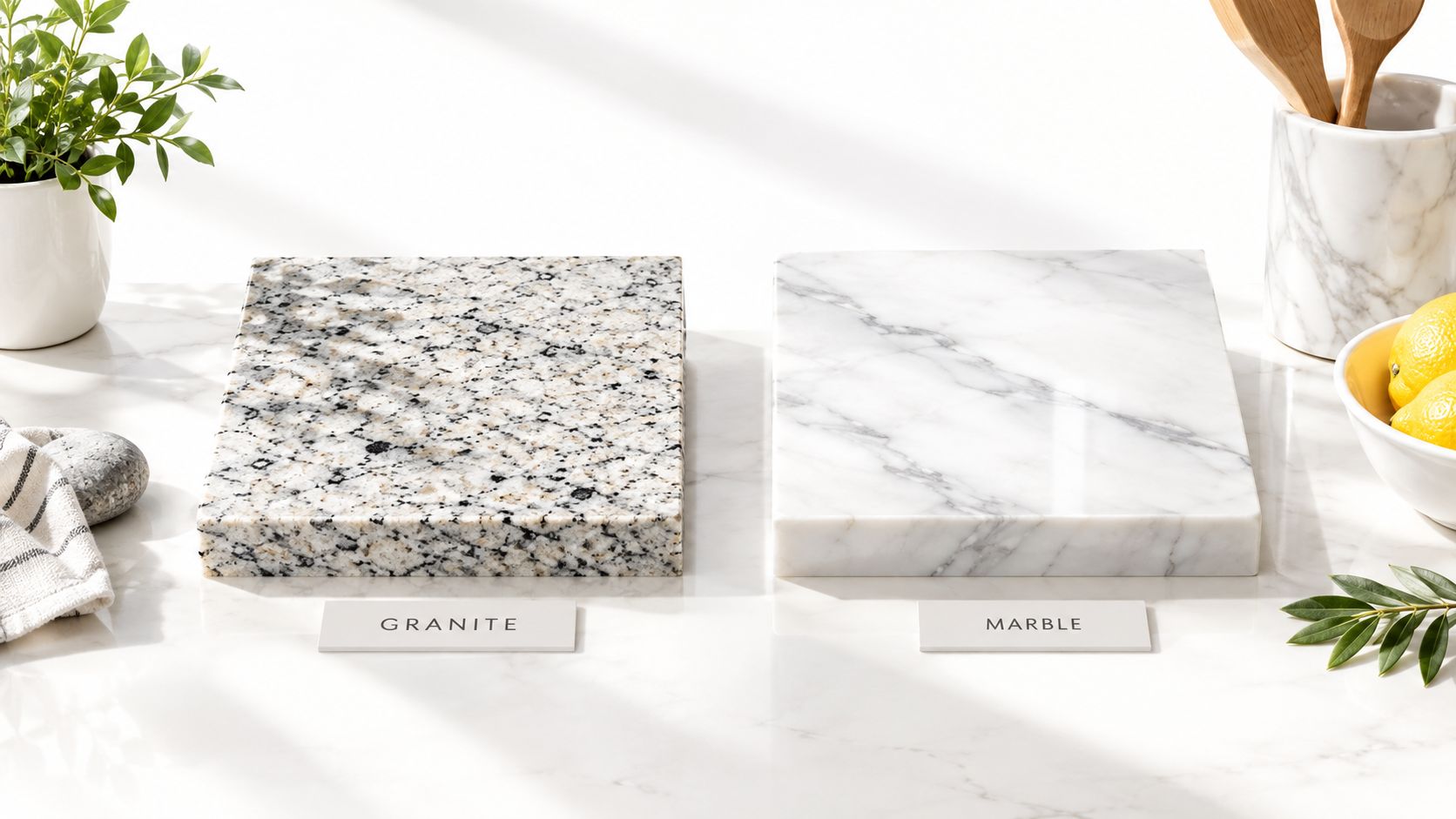
The most reliable granite marble white decision is not based on the whitest slab or the most dramatic vein. It comes from matching exposure, traffic, finish, maintenance habits, and documented test results to the room.
Visit Varun Marbles in Gurugram to compare full white granite and marble slabs, review finishes, and discuss cut-to-size fabrication for your project. Their team can support slab selection, edge profiling, finishing, and installation coordination, helping you approve the material before it reaches the cutting table.