
Engineered Stone Price: A 2026 NCR Buyer's Guide
For 20 mm engineered quartz in Delhi-NCR, budget roughly ₹400 to ₹1,100 per sq ft installed, including fabrication and site fitting. Slab-only quotations sit 20–30% below that delivered figure, so a low slab rate isn't a low project cost until cutting, edges, cut-outs, transport and installation are added.
That gap is where most NCR budgets go wrong. Buyers compare a yard rate from one supplier against a finished rate from another, assume the first firm is cheaper, then discover the missing lines after the slab is cut. Don't do that. Force every quote into the same structure and the cheapest honest option usually becomes obvious.
Table of Contents
- The Real Number Behind Engineered Stone Price in 2026
- What Engineered Quartz Is and Why It Costs Differently
- Six Drivers That Move Engineered Stone Price
- Slab-Only vs Installed Price in the NCR Market
- How Fabrication and Installation Quietly Add 20–30%
- Lifecycle Cost Versus Natural Marble and Granite
- A Buyer's Checklist for Comparing Quartz Quotes
- Where Fabrication and Installation Create Real Value
The Real Number Behind Engineered Stone Price in 2026
Treat engineered stone price as three separate layers. First comes the slab on the rack. Second comes fabrication in the workshop. Third comes transport, handling and fixing at site. If a quotation merges all three into one per-square-foot number, you can't tell what's included, what's excluded, or where you'll be charged again later.
The slab layer alone spans a wide range in this region. A regional pricing survey for Delhi-NCR countertop materials places entry-level quartz at approximately ₹180–₹300 per sq ft, Indian mid-tier products at ₹300–₹650 per sq ft, and imported quartz at ₹600–₹1,500 or more per sq ft for the slab. Those figures don't buy you a usable counter. They buy material that still needs measuring, cutting, edging, polishing at cuts, moving and fixing.
Why Two Honest Quotes Can Differ Sharply
Two fabricators can both write "engineered quartz" and price entirely different jobs. One may assume a straight polished edge, one sink cut-out and easy ground-floor access. The other may include a mitred edge, hob and sink openings, a waterfall return, difficult lift access and extra material for vein matching. The second quote isn't necessarily padded. It's pricing more work.
- Material scope: Confirm thickness, finish, colour, brand, slab size and whether wastage is charged.
- Fabrication scope: Confirm edge profile, joins, cut-outs, drainer work and finish restoration after cutting.
- Site scope: Confirm transport, carrying, substrate preparation, jointing, sealing at seams and final cleaning.
Practical rule: Never approve a single-line rate. Ask for material, wastage, fabrication and installation as four separate lines, then compare totals.
Kitchen budgets also interact with cabinets, appliances and civil work, so a countertop decision shouldn't be priced in isolation. If you're benchmarking a full renovation rather than stone alone, Premier Builders renovation pricing is a useful reminder to separate headline rates from the finished scope before you commit money. My recommendation is blunt. Judge suppliers on the delivered, installed total for an identical specification, not on who advertises the lowest slab rate. The firm that itemises clearly is usually the firm that won't surprise you at site.
What Engineered Quartz Is and Why It Costs Differently
Engineered quartz is a factory-made composite. Manufacturers combine natural quartz aggregate with resin binders and pigments, press the mixture into slabs, cure it and polish the surface under controlled conditions. You're not buying a block cut from a mountain and hoping the pattern behaves. You're buying a manufactured product designed to repeat from slab to slab.
The composition below explains why formulation matters to both performance and price.
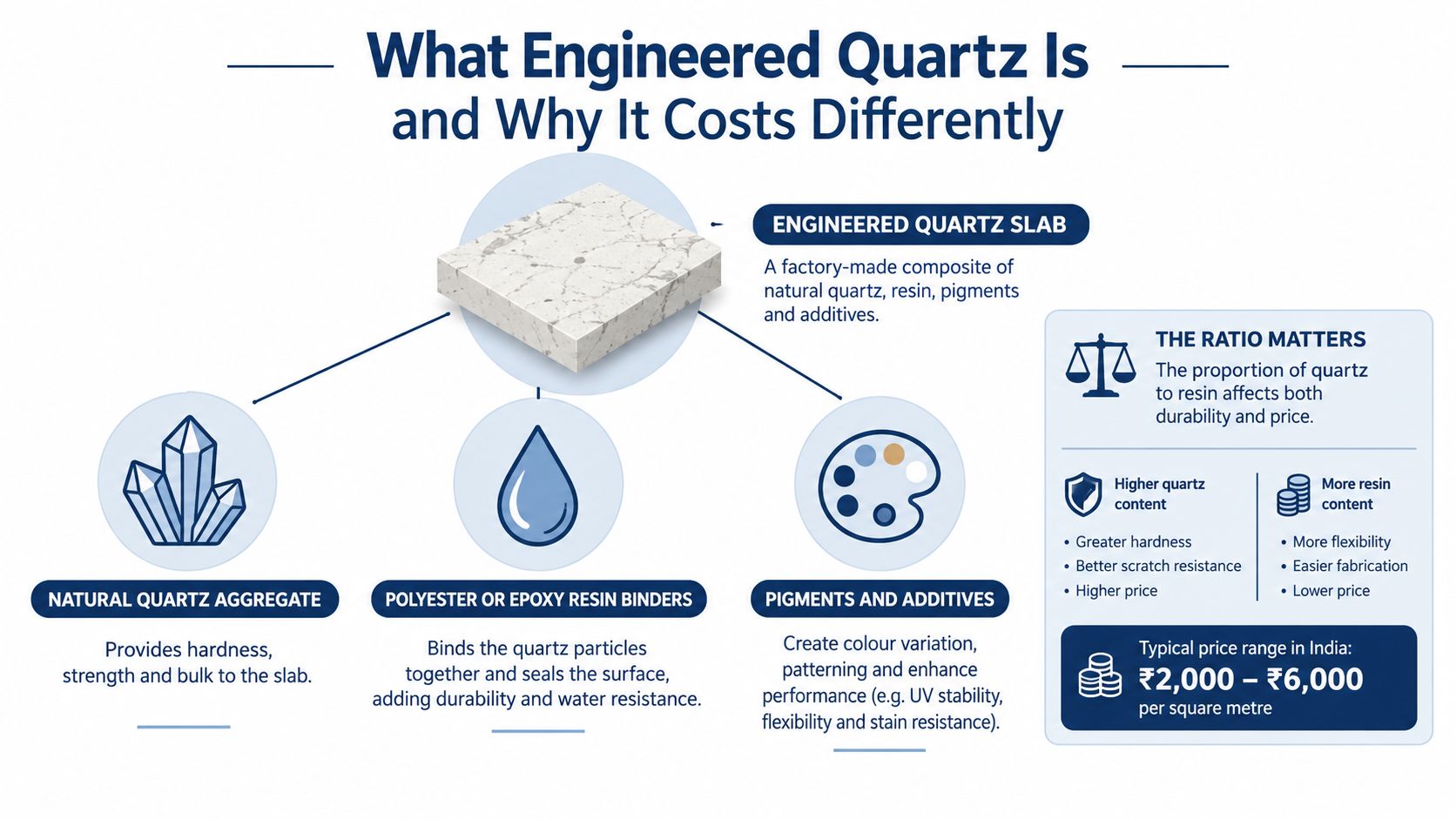
Quartz aggregate provides hardness and bulk. Resin binds the particles and helps create a non-porous surface. Pigments and additives produce the base colour, speckle or marble-style veining. Change the resin system, pigment quality, pressing control or inspection standard and you change both cost and consistency, even when two samples look similar under showroom light.
Manufactured Economics Versus Quarry Economics
Natural marble, granite and onyx are priced around the individual block and lot. Vein rarity, cracks, colour movement, yield from the block and quarry origin can move the rate sharply. Engineered quartz works differently. The factory controls the recipe and pattern, so pricing follows brand quality control, formulation, finish and design complexity more than geological rarity.
That's why ranges are generally narrower and repeat orders are easier to match. It's also why an imported marble-look design can cost far more than a plain domestic colour without being proportionally harder in daily use. You're often paying for vein realism, colour consistency, inventory and brand assurance. Pay for those things if the design needs them. Don't assume they automatically buy better kitchen performance.
If sustainability affects your specification, compare manufactured surfaces against sustainable material choices from Hutter Architects before you lock the material palette. For kitchen use specifically, our guidance on why quartz slabs suit modern kitchens covers the practical case in more detail. The key point here is simple. Engineered quartz should be quoted like a specified manufactured product, with the exact design and finish named, not bought as a generic stone category.
Six Drivers That Move Engineered Stone Price
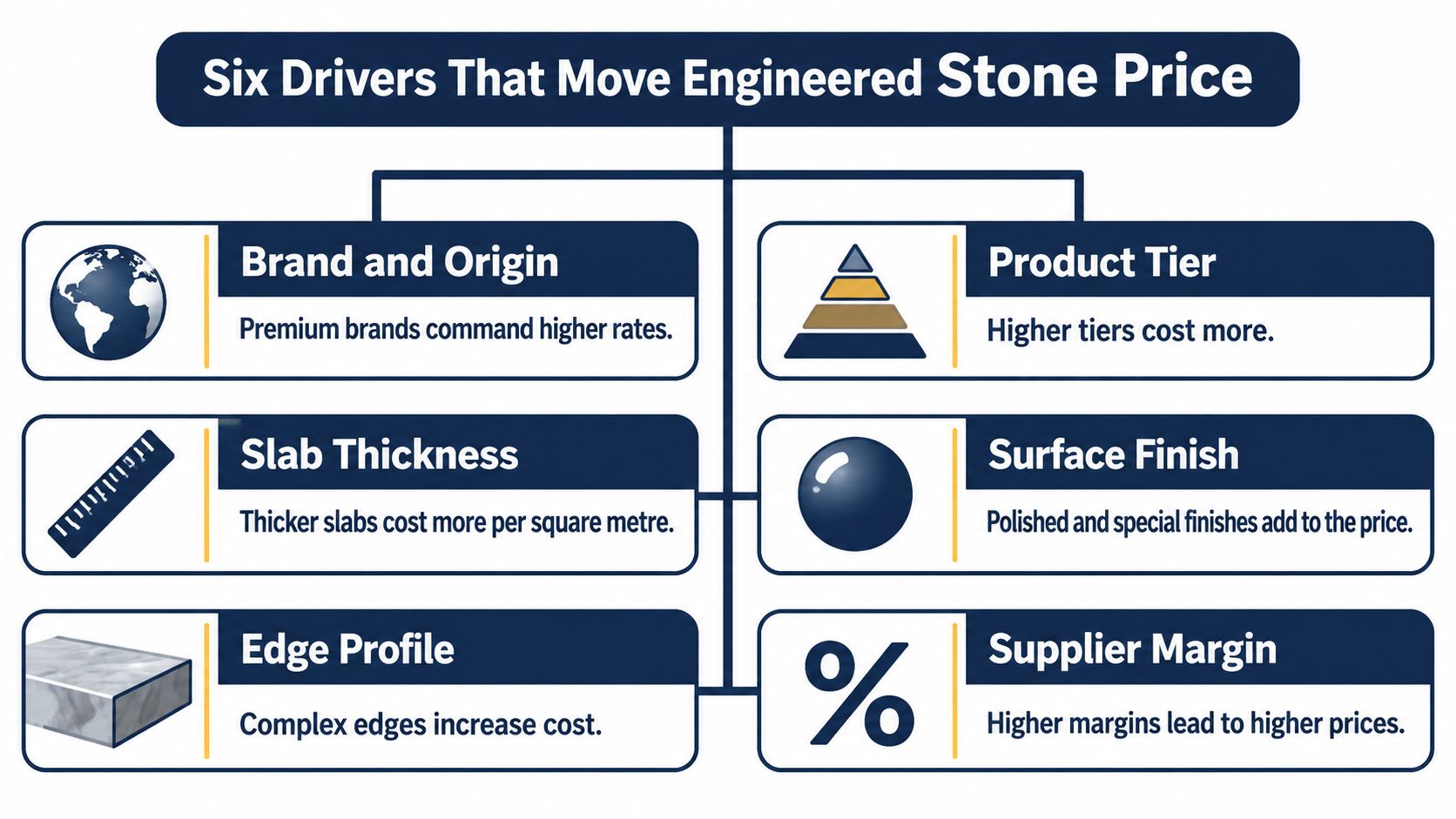
Most price movement comes from six decisions you control before ordering. Change one and the rate moves. Change three together and two kitchens with identical counter area can land far apart, even with the same fabricator.
The hierarchy below sets out those drivers before we price them.
Origin, Tier and Thickness
Brand and origin come first because they set the starting slab rate. Current supplier listings for engineered quartz in India show common 20 mm polished domestic products at approximately ₹350–₹650 per sq ft, while premium patterns and imported or luxury-grade slabs commonly extend from about ₹950 to more than ₹2,800 per sq ft. That spread reflects sorting, design value, inventory risk and brand control, not just dealer margin.
Product tier is the next filter. A flat, fine-grained colour is easier to produce and match than a dramatic Calacatta-style design with long veins. Book-matched or vein-continuous work raises the stakes again because the fabricator can't just nest pieces for maximum yield. The pattern dictates the cutting plan.
Slab thickness then affects material volume, weight, handling and edge appearance. Thicker isn't automatically better for every counter, and a built-up edge can create a substantial look without paying for full thickness everywhere. Specify what the design actually needs. Don't buy thickness as a proxy for quality.
Finish, Edge Profile and Yield
Surface finish changes processing and maintenance expectations. Polished quartz is the common benchmark. Matte and leathered finishes can alter the rate and may show handling marks differently, so inspect a large piece rather than judging from a small swatch. Confirm the exact finish in writing because "same colour" doesn't mean same product.
Edge profile is priced by length, not area, which catches buyers out. A simple straight or lightly eased edge is economical. Mitred aprons, waterfall ends and elaborate profiles need more cutting, bonding, polishing and site care. If you want to reduce cost without changing the slab, simplify the edge before you downgrade the material.
Slab yield is the driver most guides ignore. Your counter area isn't the amount of slab consumed. Offcuts, sink and hob openings, vein direction, joins and breakage allowance all reduce usable yield. A layout that forces a second slab for one short return will cost more per covered square foot than a long, efficient run. Ask to see the slab layout before approval. That's where hidden wastage becomes visible.
The short video below is useful for visualising how specification choices move from a flat slab to a finished surface.
My order of value engineering is consistent. Protect thickness and material quality where the surface works hardest, simplify decorative edges, then redesign joins and returns to improve yield. Don't start by chasing an unknown slab at a lower rate. That trades a visible saving today for colour, consistency and replacement risk later.
Slab-Only vs Installed Price in the NCR Market
Read the market in tiers, not as one rate for quartz. Indicative Indian ranges in the NoBroker guide to quartz and granite countertops run from ₹250–₹400 per sq ft for standard quartz, ₹400–₹700 for mid-range material, ₹700–₹1,200 for premium material, and more than ₹1,200 for some imported or designer products. The same source notes that fabrication and installation may add ₹150–₹400 per sq ft, which is why slab-only comparisons mislead.
Metro location matters too. That comparison also states that metro-city rates can carry a 15–20% premium over Tier-2 markets and premium edge profiles may add ₹100–₹500 per running foot, so a rate quoted outside NCR won't transfer cleanly to Gurgaon or Delhi. Labour, transport, access and workshop overheads are different, and your quote should reflect the site where the work will happen.
Slab-Only vs Installed Engineered Quartz Price Ranges in Delhi-NCR (20 mm, indicative)
| Tier | Slab-Only (₹/sq ft) | Installed (₹/sq ft) | Edge Profile Add-on (₹/rft) | Cut-out Add-on (₹/each) |
|---|---|---|---|---|
| Standard | ₹250–₹400 | Slab plus fabrication and installation | Standard profiles at the lower end | Charged per opening |
| Mid-range | ₹400–₹700 | Slab plus fabrication and installation | Higher for mitred or decorative work | Charged per opening |
| Premium | ₹700–₹1,200 | Slab plus fabrication and installation | Premium profiles priced separately | Charged per opening |
| Imported or designer | More than ₹1,200 | Slab plus fabrication and installation | Confirm profile by running foot | Confirm sink and hob count |
The table is a budgeting frame, not a substitute for a measured quote. A compact kitchen with several openings, short returns and a waterfall end carries fixed fabrication operations over very little area. Its effective cost per covered square foot rises. A long island with one join and a simple edge spreads those operations more efficiently, even if both projects use the identical slab.
Don't ask, "What's your quartz rate?" Ask, "What's the installed total for this drawing, this edge, these cut-outs and this slab layout?"
That question changes the conversation. Suppliers must expose assumptions about wastage, joins and site work instead of competing on an incomplete headline. If one total is far lower, look for missing transport, excluded edge work, thinner material or an unrealistic yield assumption. In my experience, the gap is usually scope. Margin explains less than buyers think.
How Fabrication and Installation Quietly Add 20–30%
Fabrication turns a rectangle into your kitchen. That work is skilled, sequential and easy to underprice if you only look at the slab invoice. A regional benchmark for Indian engineered quartz costs places Indian engineered quartz at roughly ₹350–₹900 per sq ft for 20 mm material, then adds approximately ₹50–₹150 per sq ft for installation, ₹80–₹200 per running foot for edge profiling, and ₹800–₹2,000 for each sink or hob cut-out. Add those lines and the delivered total changes quickly.
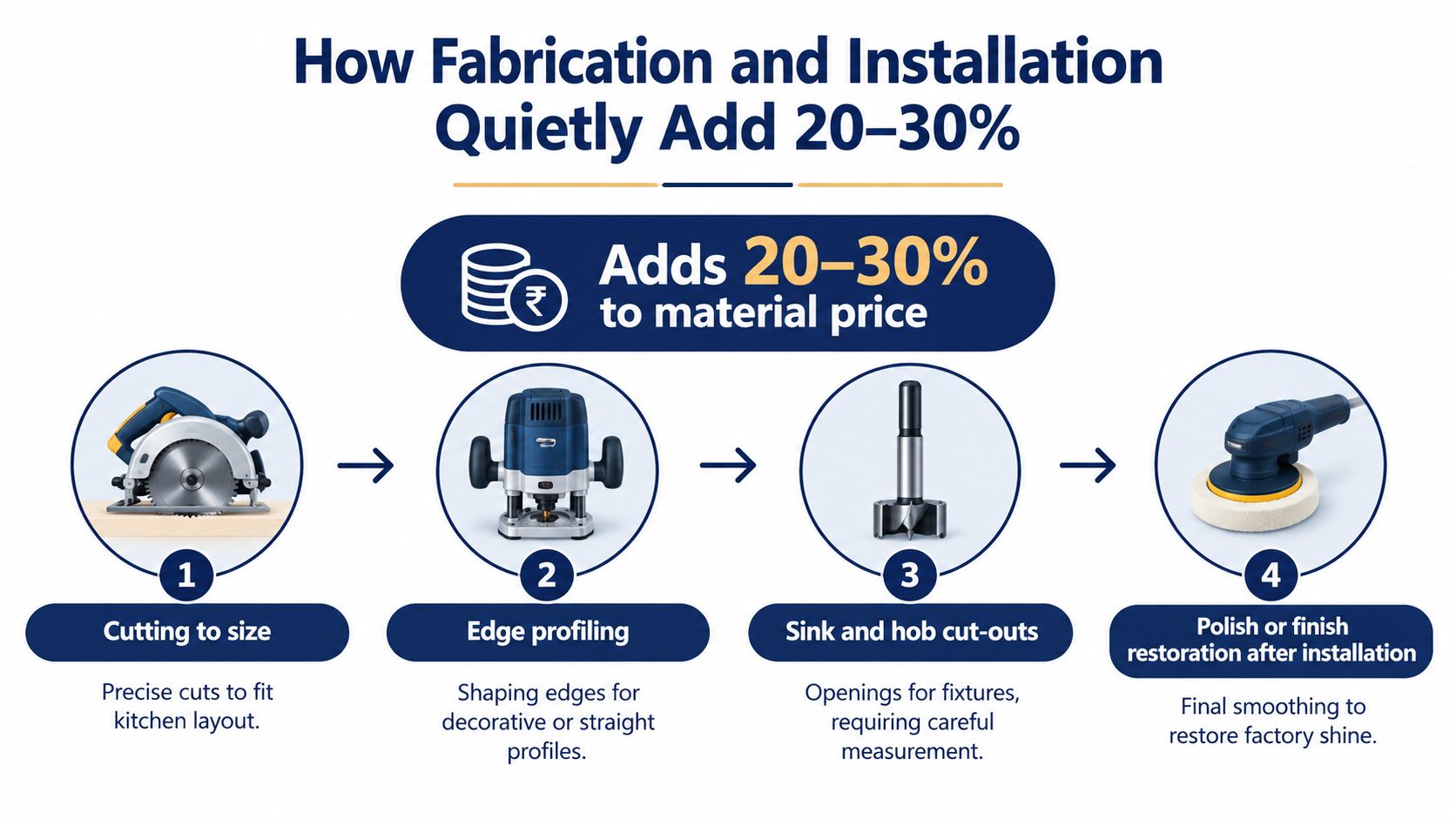
The process flow below shows where that money goes.
The Four Fabrication Lines to Itemise
- Cutting to size: The workshop templates the cabinets, checks appliance dimensions and cuts each piece to fit, including joins and returns.
- Edge profiling: Workers shape, bond and polish the visible edge, with mitred and waterfall details taking materially more time than a straight edge.
- Sink and hob cut-outs: Each opening needs accurate measurement, cutting, edge finishing and support checks before appliances or sinks are fitted.
- Finish restoration: Cut edges and joins are polished and blended so the installed surface doesn't show dull lines where the factory finish was interrupted.
Transport and site work sit on top of workshop fabrication. Slabs and finished pieces need protected handling from yard to home, then carrying, positioning and levelling. The substrate must be sound and level enough for the counter to sit correctly. Installers then joint pieces, seal at seams, fix sinks where included, align edges and clean the surface for handover. None of that is free because the slab was discounted.
Measurement discipline matters at this stage, and the principles in our guide to accurate granite slab measurements apply equally before quartz is cut. A wrong hob dimension or an out-of-square corner discovered after cutting becomes rework, delay or a visible compromise. Pay for templating and drawing approval. It's cheaper than replacing a fabricated piece.
Budgeting rule: Reserve the fabrication and installation allowance before you choose the final colour. If the allowance doesn't fit, simplify geometry first.
A low slab quote can therefore produce a high installed number once every operation is charged separately. Conversely, a higher combined quote may already include profiling, cut-outs, transport and fixing. Compare the final scope line by line. That's the only fair test.
Lifecycle Cost Versus Natural Marble and Granite
Sticker price answers what you'll pay this month. Lifecycle cost answers what the surface will demand from you over 10–15 years of cooking, cleaning, guests, tenants or staff. For a worktop, that second question matters more.
The comparison below summarises the maintenance pattern for the three main options.
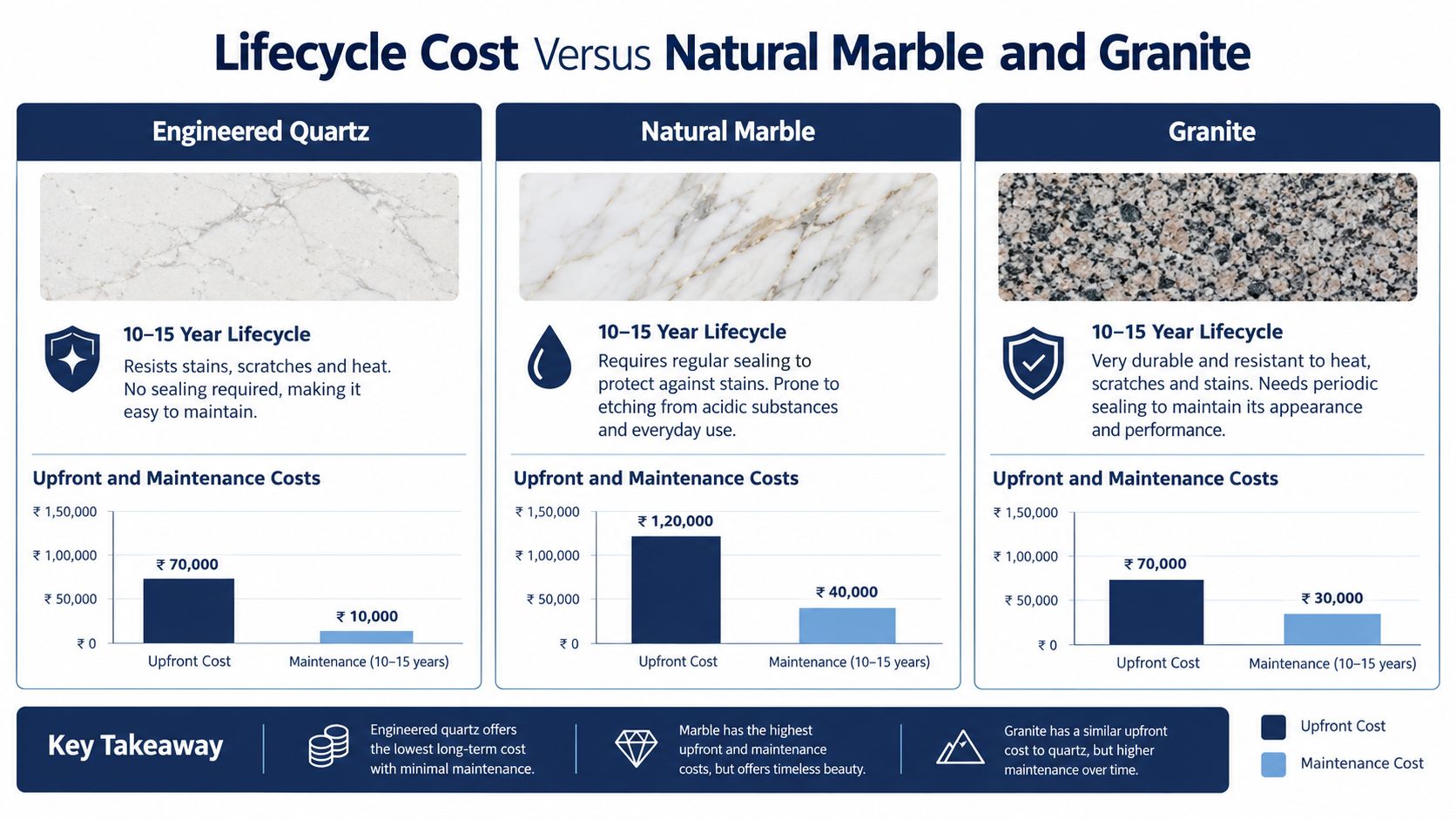
Engineered quartz starts with a practical advantage. It's non-porous, so it doesn't need routine sealing and it resists everyday staining better than marble. Routine care is mainly prompt cleaning, trivets for very hot pans and boards for cutting. For busy households and commercial counters where staff won't follow a delicate care regime, that predictability has real economic value.
Where Natural Stone Still Wins
Marble offers depth and movement that manufactured patterns still struggle to equal at close inspection. It also brings etching, staining and sealing obligations, plus a higher chance that you'll pay for repolishing or specialist repair. Choose marble for visual impact in lower-abuse areas or where resale presentation justifies the upkeep. Don't choose it for a hard-working family kitchen and then blame the stone for behaving like marble.
Granite sits between the two. It's tough, heat tolerant and well suited to heavy Indian cooking, but it generally needs periodic sealing and pattern choice varies by lot. Our comparison of marble and granite for kitchens is worth reading if you're torn between natural options. For large-format flooring, natural stone can also deliver scale and character that quartz worktop slabs aren't intended to replace.
My recommendation is application-led. Use engineered quartz for kitchen worktops, bath counters and high-use surfaces where low upkeep matters daily. Use granite where direct heat and rugged use dominate. Use marble or onyx where the visual statement is the point and the owner accepts maintenance. Don't force one material to win every room. Good procurement matches the surface to the job, then prices the full ownership burden, not just the slab.
A Buyer's Checklist for Comparing Quartz Quotes
Hand every fabricator the same checklist and refuse to compare incomplete replies. You're not being difficult. You're making the quotations comparable.
Specification Lines Every Quote Must State
- Slab identity: Brand, design or colour name, lot or batch reference, thickness, finish and slab dimensions.
- Measured scope: Counter area, slab quantity, expected wastage, join positions and vein direction.
- Fabrication details: Edge profile by running foot, sink and hob cut-out count, drainer or tap holes and finish restoration.
- Delivered scope: Transport, carrying and access assumptions, installation, seam sealing, sink fixing if included and handover cleaning.
- Commercial terms: Lead time, slab inspection rights, replacement policy for damage, warranty and what triggers a variation charge.
Inspect the full slab at the yard, not only a sample. Check colour consistency, vein scale, surface finish and any visible defects under strong light. Run simple sample checks for water behaviour and scratching where the supplier permits, and confirm that replacement material from the same batch will be available if a piece is damaged. Batch continuity matters more than a small discount.
This is value engineering in the proper sense, protecting function while removing avoidable cost. If you want the framework behind that discipline, Trail Star Development's value engineering guide explains how to cut cost without cutting performance. Apply it here by simplifying edges, reducing unnecessary joins and improving slab layout before you compromise on material quality. Then lock the approved drawing, appliance dimensions and edge detail before cutting starts. Once the saw runs, changes stop being cheap.
Where Fabrication and Installation Create Real Value
Three decisions move your final bill most. The specification tier sets the slab cost. Edge complexity drives workshop time by length. Cut-out count and layout geometry determine how much fixed fabrication is spread across your counter area. Control those three and you control the budget without gambling on an unknown material.
Scale also explains why the market now supports so many tiers. India's engineered-stone revenue is reported at approximately US$889.6 million in 2025, with a projection of US$1.5796 billion by 2033, in the India engineered stone market outlook from Grand View Research. More choice helps buyers, but only if specifications stay transparent. A wider market makes vague quotations less excusable, not more.
Real value comes from one accountable chain. Material selection, slab inspection, cutting, finishing and installation need to agree with each other. Varun Marbles provides that linked support from its Gurugram showrooms at Sikanderpur Marble Market and HUDA Marble Market Sector 33–34, where buyers can inspect slabs and resolve fabrication scope before ordering. Chasing the lowest slab rate across disconnected suppliers often costs more in rework, delay and mismatched pieces. Buy the finished surface, with the drawing and scope priced properly. That's the competitive engineered stone price.
Bring your kitchen drawing, appliance dimensions and preferred edge profile to Varun Marbles and ask for an itemised installed quotation covering slab, wastage, fabrication, transport and fixing. Inspect the actual quartz slab at the Sikanderpur or HUDA Sector 33–34 showroom, approve the cutting layout before work begins, and compare the delivered total against any competing quote on the same specification.