
Engineered Marble Countertops Explained for Indian Homes
You're probably standing in a slab gallery or scrolling through countertop photos, trying to decode a familiar argument. One person says marble is unmatched for beauty. Another says engineered surfaces are easier to live with. Then someone warns you that “engineered marble” is just marketing language, while a fabricator tells you it matters more how the slab is cut than what colour it is.
That confusion is normal, especially in Gurugram and the wider NCR, where kitchens deal with heat, dust, hard water, heavy daily use, and fast renovation timelines. A surface that looks perfect on a sample chip can behave very differently once it's installed around a hob, near a sunny window, or over cabinets that aren't perfectly level. The right choice isn't only about stain resistance. It's about specification, fabrication, support, and realistic care.
Table of Contents
- Why Engineered Marble Countertops Suit Busy Indian Kitchens
- What Engineered Marble Really Is and How It Is Made
- Engineered Marble Compared With Natural Stone Options
- How to Choose Colours Finishes and Slab Specifications
- Fabrication and Installation Without Costly Surprises
- Staying Safe During Cutting and Caring for Your Countertop
- Your Confident Next Step Toward the Right Countertop
Why Engineered Marble Countertops Suit Busy Indian Kitchens
A couple renovating a flat in Golf Course Road often starts with the same wish. They want the soft, premium look of marble, but they don't want every tea spill, masala splash, or hurried weekday meal to feel risky. That's where engineered marble countertops enter the conversation. They sit in a useful middle ground for buyers who want a marble-like aesthetic with a more controlled, factory-made surface.

India's countertop story makes more sense when you look at the broader stone ecosystem first. The Indian Bureau of Mines marble profile reports approximately 1,945 million tonnes of marble resources, with only about 4.5 million tonnes, or 0.23%, classified as reserves, while 1,941.3 million tonnes, or 99.77%, remain in the resource category. The same source also notes that marble is India's most preferred dimension stone. For a homeowner or designer, that matters because it shows the sheer depth of India's stone base, even though geological resource and commercially extractable reserve aren't the same thing.
Why Rajasthan matters to your kitchen platform
When you hear suppliers, transporters, and fabricators talk about stone availability, Rajasthan comes up for a reason. It sits at the centre of a huge part of India's stone processing and supply chain, which affects how slabs move, how quickly projects get serviced, and how much selection buyers can see in NCR yards and showrooms.
A practical result of that ecosystem is choice. You're not selecting in isolation. You're choosing from a surface market built on quarrying, processing, polishing, transport, and fabrication capacity that has developed over years, and that's one reason engineered surfaces are now so common in urban kitchens.
Practical rule: If you like the look of marble but want a more standardised surface for everyday use, engineered marble is worth considering, but only if you judge it as a technical product, not just a colour swatch.
For readers also comparing related surfaces, this guide on why quartz slabs work in modern kitchens is a useful companion because it helps separate “marble look” from day-to-day performance. That distinction becomes important once you start asking the questions that really matter, how the slab is made, how it should be specified, where heat becomes a risk, and what a safe installation looks like.
What Engineered Marble Really Is and How It Is Made
Engineered marble isn't quarried as a finished slab from the earth the way natural marble is. It's a manufactured stone surface, made by combining mineral particles with binders in a controlled factory process. That's why it can look consistent from slab to slab, and also why it behaves differently from natural marble under heat, cutting, and fabrication stress.
Here's the simplest way to picture it. Natural marble is like a loaf baked by geology, every piece different. Engineered marble is more like a carefully standardised mix. Manufacturers decide the blend, press it into slab form, cure it, then finish the surface so it can be used for kitchen platforms, vanity tops, table tops, stairs, and interior facings.
A quick visual helps make that process easier to understand.
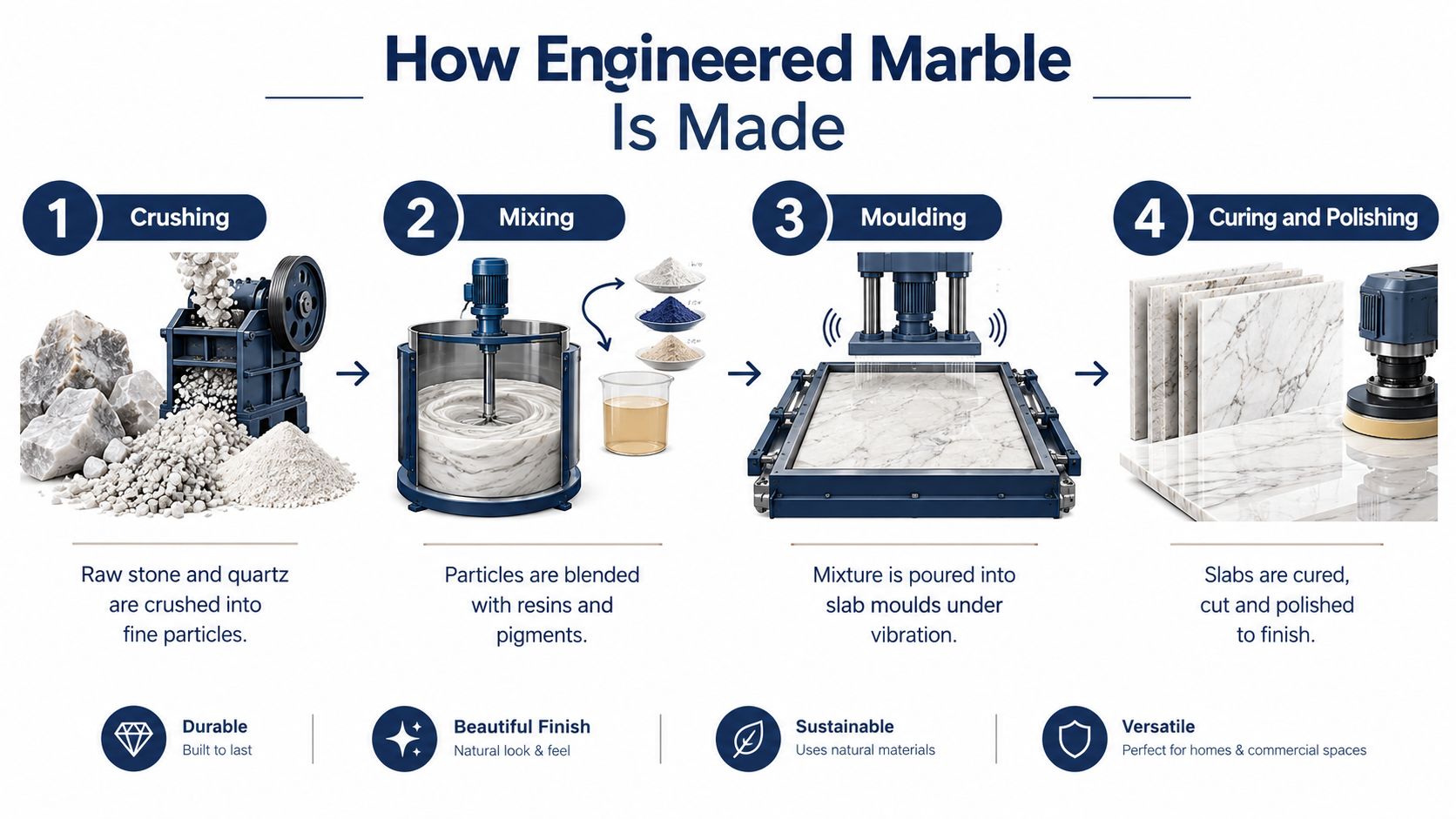
The basic manufacturing stages
Most buyers don't need factory jargon. They need a reliable mental model.
Mineral preparation
Stone particles or mineral fillers are selected and graded. This affects the look, body colour, and how uniform the slab appears.Mixing with resin and pigments
A binder holds the particles together. Pigments help create the final shade, and veining or pattern effects are designed at this stage.Moulding and compression
The blend is formed into slab shape under controlled conditions so it becomes dense and consistent.Curing, calibration, and finishing
The slab is cured, cut, thickness-calibrated, and polished or otherwise finished. That's how you get polished, matte, or textured looks depending on the product line.
Later in the section, you can see a process video that shows why surface consistency and edge quality depend so much on factory control.
Why India's processing history matters
This product category didn't appear out of nowhere. The Indian Bureau of Mines yearbook on marble recorded that India's marble-production value rose from ₹1,395.42 crore in 2010–11 to ₹1,601.24 crore in 2011–12, an increase of about 14.7%, and that Rajasthan accounted for about 95% of national marble output value in 2011–12. The same publication estimated roughly 1,000 million square feet of slab-production capacity annually and approximately 3,000 million square feet of polished-tile capacity annually. It also notes that slabs were used for interior and exterior facings, stairs, table tops, and kitchen platforms.
That industrial base matters because modern engineered surfaces depend on the same wider ecosystem of cutting, polishing, distribution, and fabrication. In plain terms, India already had the habits and infrastructure needed to turn mineral inputs into standardised interior surfaces.
A full slab tells you more than a sample chip ever will. Pattern repeat, body consistency, and edge appearance only become clear when you see the actual slab.
What readers often confuse
The biggest mistake is assuming all engineered stone is the same. It isn't. Some products are made to mimic marble, some behave closer to quartz categories, and many are sold with overlapping trade language. That's why the next decision shouldn't be “Do I like this white slab?” It should be “How does this material compare with natural marble, granite, and engineered quartz in the way I cook and clean?”
Engineered Marble Compared With Natural Stone Options
The fastest way to get clear is to stop asking which surface is “best” and start asking best for what. A family kitchen in Gurugram that sees pressure cookers, hot tawas, and fast cleaning needs different priorities from a powder-room vanity or a calm apartment pantry. Engineered marble countertops can be a smart fit, but only if you compare them fairly with the alternatives.
What changes in daily use
Natural marble attracts people because no two slabs are identical. It has depth, softness, and natural movement that designers love. But it's also a natural stone with its own maintenance expectations. Engineered marble usually gives you a more controlled visual, more repeatable veining, and a more standardised surface. Granite tends to be chosen where buyers want a tougher-feeling, lower-fuss natural stone. Engineered quartz often enters the shortlist when uniformity and easier routine upkeep matter most.
For a broader design perspective on how professionals weigh countertop categories, the overview from Jennifer Gilmer Kitchen & Bath countertops is useful because it frames countertop selection around actual use, not showroom impressions alone.
Engineered Marble vs Natural Stone Countertop Choices
| Material | Look and Consistency | Porosity and Stains | Heat and Scratch Notes |
|---|---|---|---|
| Engineered marble | Marble-like look with more controlled patterning and repeatability | Usually more controlled than natural marble because it's factory-made | Needs care around hot cookware and cut-out areas, and it shouldn't be treated as immune to scratching |
| Natural marble | Unique veining and one-of-a-kind variation | More dependent on the stone's natural structure and maintenance habits | Better chosen by people who accept patina and variation as part of the material |
| Engineered quartz | Very consistent appearance, from subtle to dramatic patterns | Commonly selected when buyers want a low-penetration engineered surface | Resin-based composition means heat discipline still matters |
| Granite | Natural variation, often busier or more granular visually | Popular where buyers want a hard-working natural stone option | Generally preferred for robust kitchen use, though finish and colour still affect how it wears |
How to decide without getting lost
A helpful shortcut is to match the material to your habits.
- If visual softness matters most, engineered marble can deliver a marble-style appearance with more consistency than natural stone.
- If you want natural individuality, marble and granite stay in the conversation because no factory pattern fully replaces a geological one.
- If your kitchen runs hot and fast, ask harder questions about trivets, cut-outs, edge details, and warranty terms.
- If you want the easiest specification process, engineered products often make paperwork and matching more straightforward.
For readers comparing marble and granite options in more detail, this guide to kitchen marble and granite choices can help sharpen the shortlist before you visit local markets.
The wrong comparison is “Which one looks premium?” The right comparison is “Which one still works for my cooking habits six months after installation?”
That's where many buyers get tripped up. They choose by finish name, not by behaviour under Indian kitchen conditions. Once you understand that, the next step is much more technical, and much more useful, the slab specification.
How to Choose Colours Finishes and Slab Specifications
Most disappointments don't begin after installation. They begin in the showroom, when a buyer approves a slab by colour name alone. That's risky with any surface, but especially with engineered marble-look materials, where tone, vein direction, finish, edge details, and technical paperwork all affect the final result.
A simple checklist makes the decision less emotional and much safer.
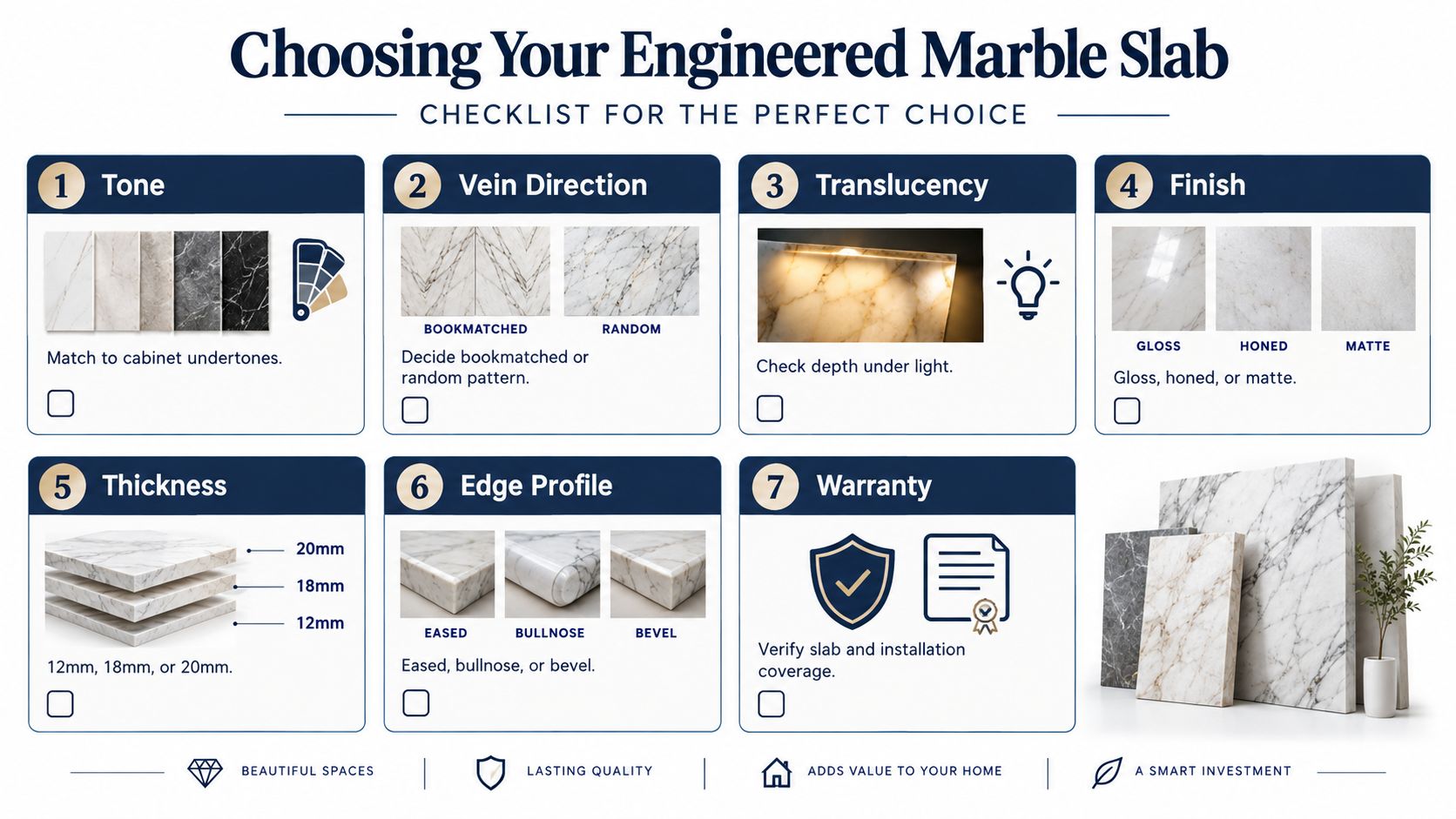
Start with the slab, not the sample
A small chip can't show you how a bold vein turns at a corner, where the quiet patch sits for a sink cut-out, or whether one slab has a warmer undertone than the next batch. In a Gurugram gallery, stand back from the slab first. Then walk up close.
Check these in person:
- Tone under real light. Warm whites, blue whites, and cream whites can all look “white” on a phone.
- Vein direction. A long island needs intentional flow. Random placement can make an expensive slab look disorganised.
- Finish behaviour. Polished, matte, and textured surfaces reflect light differently and show fingerprints differently.
- Edge appearance. The edge tells you whether the visual works convincingly once fabricated.
Ask for the specification documents
For Indian projects, engineered marble should be treated as an engineered-stone specification, not assumed to follow natural-marble rules. The guide from StudioMatrx on quartz vs granite countertops in India notes that BIS identifies IS 17572 as the Indian Standard for engineered-stone slabs, while natural marble is covered separately by standards such as IS 1130 and test methods in the IS 1121/1122 series. That distinction is practical, not academic.
When you specify an engineered slab, ask for:
- IS 17572 conformity documentation
- Declared slab thickness and dimensional tolerances
- Water-absorption test results
- Flexural or bending performance details
- Surface-finish consistency information
- Batch identification
- Approved shop drawings before cutting
Selection note: Don't approve a slab solely by colour card or nominal thickness. Ask for the technical datasheet, then inspect the actual delivered slab before fabrication.
A showroom conversation that actually helps
This is also the point where product families and inventory matter. In Gurugram, buyers comparing Kalinga Stone and AGL Quartz options for floors, walls, and countertops should ask practical questions, not just aesthetic ones. If a supplier also handles cut-to-size work and installation coordination, that can reduce handoff errors between slab selection and site execution. Varun Marbles is one such local option, with showroom-based slab viewing and fabrication support, but the key is the process rather than the brand mention. Ask any supplier to show the slab, the datasheet, the batch, and the drawing before you sign off.
Fabrication and Installation Without Costly Surprises
A countertop rarely fails because the slab looked wrong in the yard. It usually fails because something went wrong between templating, support, cut-out planning, fabrication, and site installation. That's why a good installation starts long before the slab reaches your home.
What the shop drawing must show
An approved shop drawing shouldn't be a vague sketch. It should show the full countertop layout, seam locations, sink and hob cut-outs, overhangs, backsplash returns, edge profiles, and vein direction where relevant. If the drawing doesn't show how the fabricator intends to use the slab, you're approving blind.
For engineered marble-look slabs, this matters even more around stress points. Openings for sinks and hobs create vulnerable zones. Tight internal corners increase stress concentration. A fabricator who rounds internal corners generously and plans reinforcement where needed is reducing the chance of future trouble.
The support rules buyers often miss
Engineered slabs need full, level cabinet support. They shouldn't be expected to bridge poor joinery or twisted carcasses. Before installation day, check that cabinets are aligned, fixed properly, and ready to receive stone without rocking or gaps.
Use this as a site checklist:
- Level base first. Don't ask the slab to solve a carpentry problem.
- Reinforce around cut-outs. Sink and hob areas need careful handling during fabrication and carrying.
- Inspect before cutting. Look for warpage, edge damage, shade mismatch, and how the vein runs.
- Confirm edge profile and overhang. Small profile changes can alter the whole visual weight of the counter.
If a slab arrives chipped, twisted, or visually different from the approved piece, stop before fabrication. After cut-outs begin, your options shrink quickly.
From yard to site without confusion
A clean workflow usually follows this order. Final cabinets are installed. Templating is done. The slab is matched to the drawing. Fabrication happens off-site under controlled conditions. Then the pieces are transported, dry-fitted, fixed, seamed, and checked again after installation.
What buyers often underestimate is coordination. The plumber, hob supplier, carpenter, and stone team all affect whether the finished counter looks intentional or patched together. That's why you should insist on one final pre-install review covering faucet holes, sink model, hob dimensions, access route, and site readiness. On a tight NCR fit-out schedule, that single review can prevent multiple avoidable delays.
Staying Safe During Cutting and Caring for Your Countertop
Many buying guides treat “low maintenance” as if it settles the whole matter. It doesn't. A countertop can be fairly easy for the homeowner to clean and still create serious risk during fabrication if the cutting process is poorly controlled. That's the part many buyers never see.
The British Safety Council's India coverage on artificial stone and silicosis explains that cutting, grinding and polishing silica-containing engineered stone can generate respirable crystalline silica, and that exposure is created specifically during fabrication and installation operations. The same article cites a benchmark exposure limit of 0.1 mg/m³ under referenced HSE guidance. For project teams in NCR, that changes what a “good installation” means.
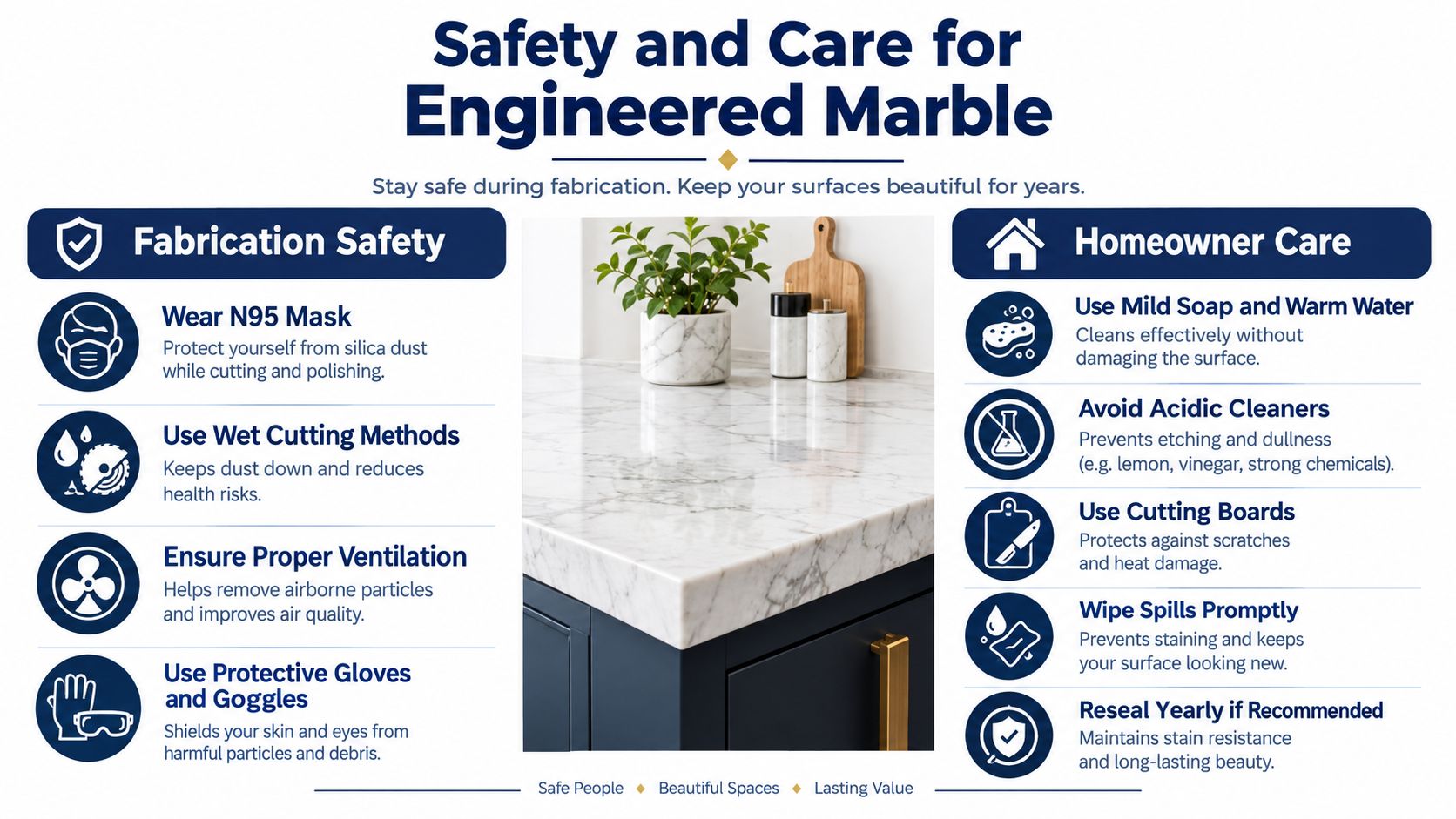
What safe fabrication should include
If your slab contains silica-bearing engineered stone components, ask the fabricator how dust is controlled. Don't settle for “We handle it.”
A sensible procurement clause should require:
- Wet cutting or effective on-tool dust extraction
- No uncontrolled dry grinding
- Suitable respiratory protection
- Housekeeping that avoids dry sweeping
- Worker training and a documented method statement
- Slurry management so dried residue doesn't become airborne later
This isn't just about workshop workers. Poorly controlled cutting can also spread dust into occupied homes, corridors, retail units, and adjacent finishes.
Low maintenance for the owner doesn't automatically mean low impact for the people cutting the slab.
Heat care in real NCR kitchens
The second myth is that engineered surfaces are “heat resistant”, end of story. In practice, everyday kitchen warmth isn't the same as sudden localised heat. A hot pressure cooker, tawa, or vessel taken directly from flame or oven can stress the resin phase in engineered materials. So can concentrated sun near glazing combined with poor ventilation and an already stressed cut-out area.
A safer routine looks like this:
- Use trivets and hot pads, especially near the hob and serving zones.
- Don't test the surface with direct hot cookware just because a salesperson sounded confident.
- Wipe spills promptly with mild soap and water, then dry the area.
- Avoid aggressive acidic or abrasive cleaners.
- Use chopping boards, not the slab itself.
If hard water is part of your cleaning battle, this guide on removing hard water stains from marble helps distinguish residue problems from actual surface damage, which is a useful habit even when your top only has a marble look rather than natural marble composition.
Your Confident Next Step Toward the Right Countertop
By this point, the choice looks different. It isn't “marble beauty versus quartz practicality” anymore. It's a more grounded decision about appearance, specification, fabrication safety, support conditions, and care discipline. That's the mindset that protects both the finish and the people handling it.
One more fact puts that responsibility in perspective. A 2025 Indian scoping review on silicosis in silica-exposed industries found a pooled silicosis prevalence of 25.98% across 11 studies covering 2,072 workers, and one Gujarat study in that review identified 24 silicosis cases and 33 cases of silico-tuberculosis among former quartz-crushing workers. That doesn't mean an installed countertop is making a household unsafe. It means buyers, architects, and contractors should stop treating fabrication safety as somebody else's problem.
A simple sign-off checklist
Before you approve any engineered marble countertop, make sure you can answer yes to these:
- Have you seen the full slab, not just a sample?
- Do you have the technical datasheet and IS 17572-related specification details?
- Has the shop drawing been approved with cut-outs, seams, and vein direction shown?
- Will fabrication use wet cutting or proper dust extraction?
- Do you know the care rules for heat, cleaning, and everyday use?
That's what confidence looks like in a Gurugram showroom. Not a quick “this one looks nice”, but a decision that still makes sense after installation day.
If you're choosing for a home, hospitality fit-out, or commercial interior, take your time with the slab, the paperwork, and the fabrication method. The right countertop isn't only attractive. It's correctly specified, safely processed, and suited to how your space really works.
If you'd like to compare marble-look engineered surfaces, natural stones, and countertop-ready slab options in person, Varun Marbles offers Gurugram showroom access, slab viewing, and coordination for fabrication and installation. Visit with your kitchen plan, cabinet layout, and appliance sizes, and you'll be able to assess finish, vein flow, support details, and specification questions before the slab is cut.