
Desert Green Granite Guide for Countertops and Flooring
You're probably looking at a sample rack, a slab yard photo, or a contractor's shortlist and noticing the same stone appear again and again. Someone calls it a practical green granite. Someone else says it's good for counters, stairs, flooring, even exterior work. But what you often don't get is the part that matters most when money and site conditions are real: why Desert Green granite keeps getting specified, and when it's the smart choice.
That question comes up often in NCR projects. A homeowner wants a kitchen surface that won't feel too dark or too delicate. An architect needs a green-toned stone that can repeat across lobby flooring, lift cladding, and staircase details without turning into a sourcing headache. A fit-out team wants something durable and familiar to fabricators, but not priced like a statement import. Desert Green often lands in that conversation because it sits in a useful middle ground. It has character, but it usually behaves like a project stone rather than a fragile showpiece.
It also isn't some newly marketed colour dressed up for current taste. Desert Green has been part of India's granite trade for a long time, especially within Rajasthan's mature processing belt. If you've been browsing broader Indian granite options, this overview of South Indian granite colours helps frame where green granites sit within the wider market, even though Desert Green itself is typically associated with Rajasthan supply.
Table of Contents
- Introduction Why Desert Green Granite Keeps Showing Up in Projects
- What Desert Green Granite Is and How It Looks Up Close
- Technical Properties That Matter for Specification
- Finishes and How They Change Look and Performance
- Where Desert Green Works Best and Where to Think Twice
- How to Source Select and Specify Desert Green Granite in NCR
- Maintenance Sealing and Long Term Care Made Simple
Introduction Why Desert Green Granite Keeps Showing Up in Projects
A kitchen island gets approved in phase one. Six months later, the same home needs matching window sills, two bathroom thresholds, and a utility counter. In NCR, that is often where material choices become expensive. A dramatic imported slab may look strong on day one, then turn awkward when the builder needs a small re-order. Desert Green keeps showing up because it is usually easier to match, easier to fabricate, and easier to buy again without reopening the whole design decision.
That repeatability has real project value. For a Delhi, Gurgaon, or Noida job, a phase-two re-order for thresholds or skirting is often far simpler with an established Rajasthan granite than with a premium import or a quartz shade that has changed batch tone. In practical terms, suppliers can often arrange small follow-up quantities of Desert Green faster than a fresh custom import cycle, which helps when handover dates are already tight.
The stone also sits in a useful middle band on cost. It gives a natural-stone surface with more field tolerance than many premium patterned granites, yet it usually avoids the price jump that comes with imported greens or highly decorative Indian slabs. That is why it appears in homes, common areas, staircases, lift surrounds, and exterior zones where designers want one material family to do several jobs.
There is a performance logic behind that choice. Quartz can be a very good answer for controlled interior counters with tight colour consistency. Premium granites can justify their price when movement, rarity, or bookmatched impact is the main goal. Desert Green makes more economic sense when the brief is broader. Repeated use, fabricator familiarity, outdoor suitability, and manageable replacement planning all matter more than showroom drama.
Its long trade presence also reduces specification risk. Desert Green has been part of India's granite trade for years within Rajasthan's processing network, which is one reason NCR buyers often see it treated as a dependable project stone rather than a fashion colour. If you want wider context on how green and neutral Indian granites sit within the market, this overview of South Indian granite colours and stone options is a useful comparison point.
For architects and homeowners, the better question is not whether Desert Green is attractive. The better question is where it gives the right mix of appearance, supply stability, and specification confidence.
That includes details buyers often miss early. Can the stone hold up on a staircase edge. Will a polished finish become too reflective in a lobby. Is the slab selection consistent enough for a large floor. Do the dimensions and finish tolerances suit BIS-aligned site expectations and local fabrication practice in NCR. Those are the questions that determine whether Desert Green is available, or the right stone.
What Desert Green Granite Is and How It Looks Up Close
A homeowner in Gurgaon sees the name Desert Green and expects a bold green stone. Then the slab arrives and reads closer to olive-grey with black mineral movement. That surprise is common, and it is one reason this granite needs to be judged in person, not by the name alone.
Desert Green granite is an Indian stone traded widely in standard project formats such as slabs, tiles, and cut sizes. In practical terms, that matters. Stones that keep circulating in these formats are usually being specified for repeatable work, such as floors, staircases, wall cladding, counters, and exterior areas, where availability and replacement planning affect cost just as much as appearance.
The colour reads more neutral than the name suggests
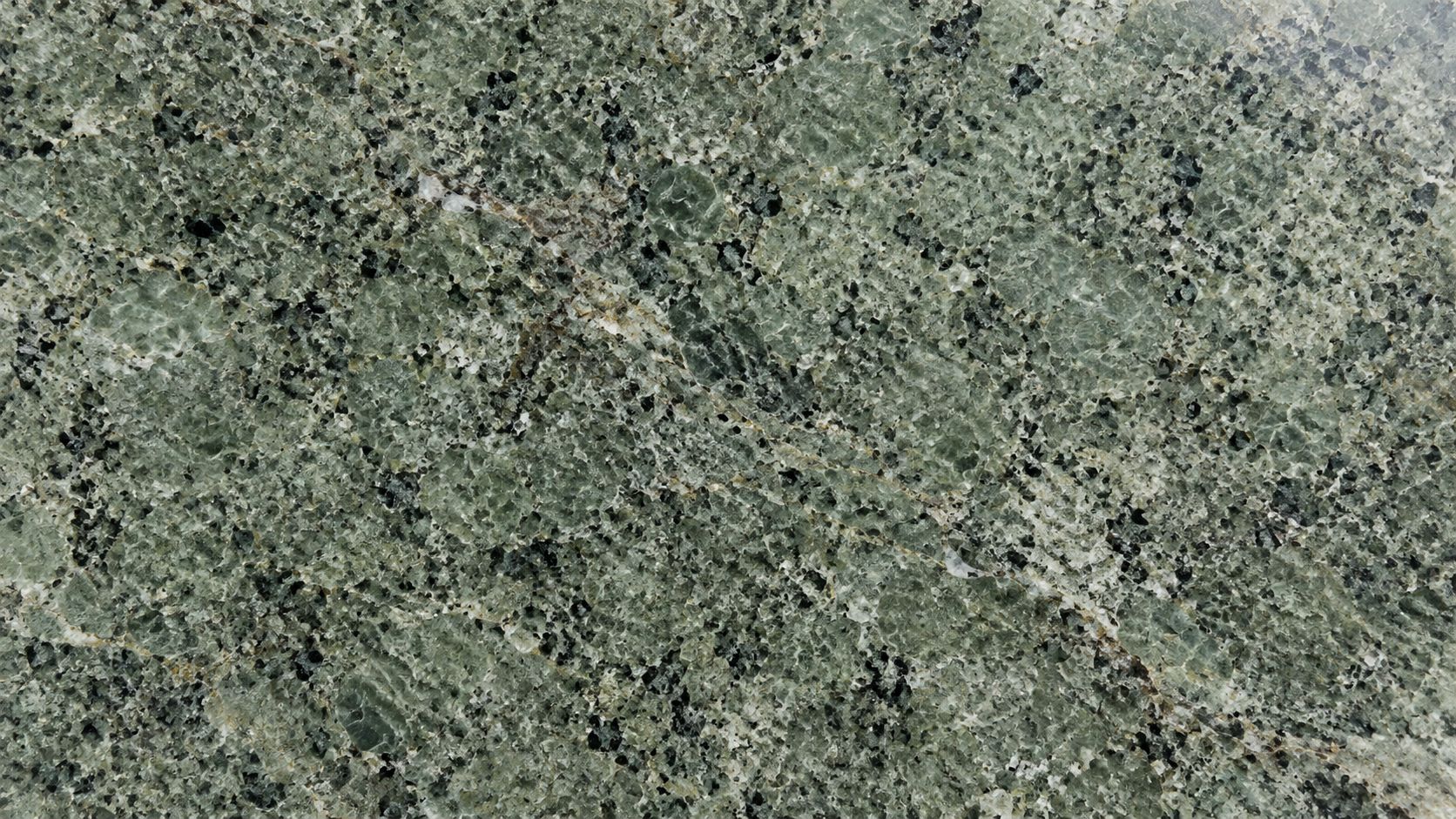
Up close, Desert Green usually shows a muted green-grey base with darker speckles and occasional warm brown flecks. The effect is quieter than many first-time buyers expect. Olive fabric with charcoal grain is a closer comparison than emerald or bottle green.
That softer appearance explains why the stone often sits comfortably beside beige paint, wood veneers, black metal, and off-white cabinetry. It behaves like a neutral stone with a green undertone, which is very different from a dramatic statement granite.
What you should actually inspect on the slab
Natural stone should be checked like timber, not like printed ceramic. You are not looking for machine-made sameness. You are checking whether all pieces belong to the same visual family.
When reviewing Desert Green, focus on these points:
- Base shade under site lighting: The same slab can read greener in daylight and greyer under warm LEDs.
- Mineral density: Some lots look tight and peppered. Others feel calmer and more open.
- Warm flecks: Brown or rust-toned marks may add depth, or they may fight a cool minimalist palette.
- Lot consistency: Multi-slab orders should be approved together, especially for large floors or long counters.
- Edge areas and corners: These reveal fissures, resin fill, and colour shifts that small samples often hide.
A hand sample gives you colour. A full slab gives you risk control.
Why this matters for specification and value
Desert Green often makes sense when a project needs a natural stone look without moving into the price band of rarer premium granites. It also solves a different problem than quartz. Quartz usually wins when you need very tight colour control on kitchen counters. Desert Green becomes attractive when you want natural variation, outdoor use, and a stone that can be ordered in more than one format for the same project.
That is especially relevant in NCR, where many projects mix interior and exterior stone use and where replacement from a similar lot may matter later. For architects working to BIS-aligned expectations, the visual review stage is not just about taste. It is part of choosing a stone that will look consistent enough across the actual application, whether that means lobby flooring, stair treads, or balcony thresholds.
Technical Properties That Matter for Specification
A slab yard sample can look convincing in five minutes. A project team still has to answer harder questions. Will the stone stay stable around sinks, perform on lobby floors, and justify its cost against quartz or a more expensive premium granite?
For Desert Green, the useful technical checks are the simple ones. They help you decide whether the stone fits the job, not just whether the colour works.
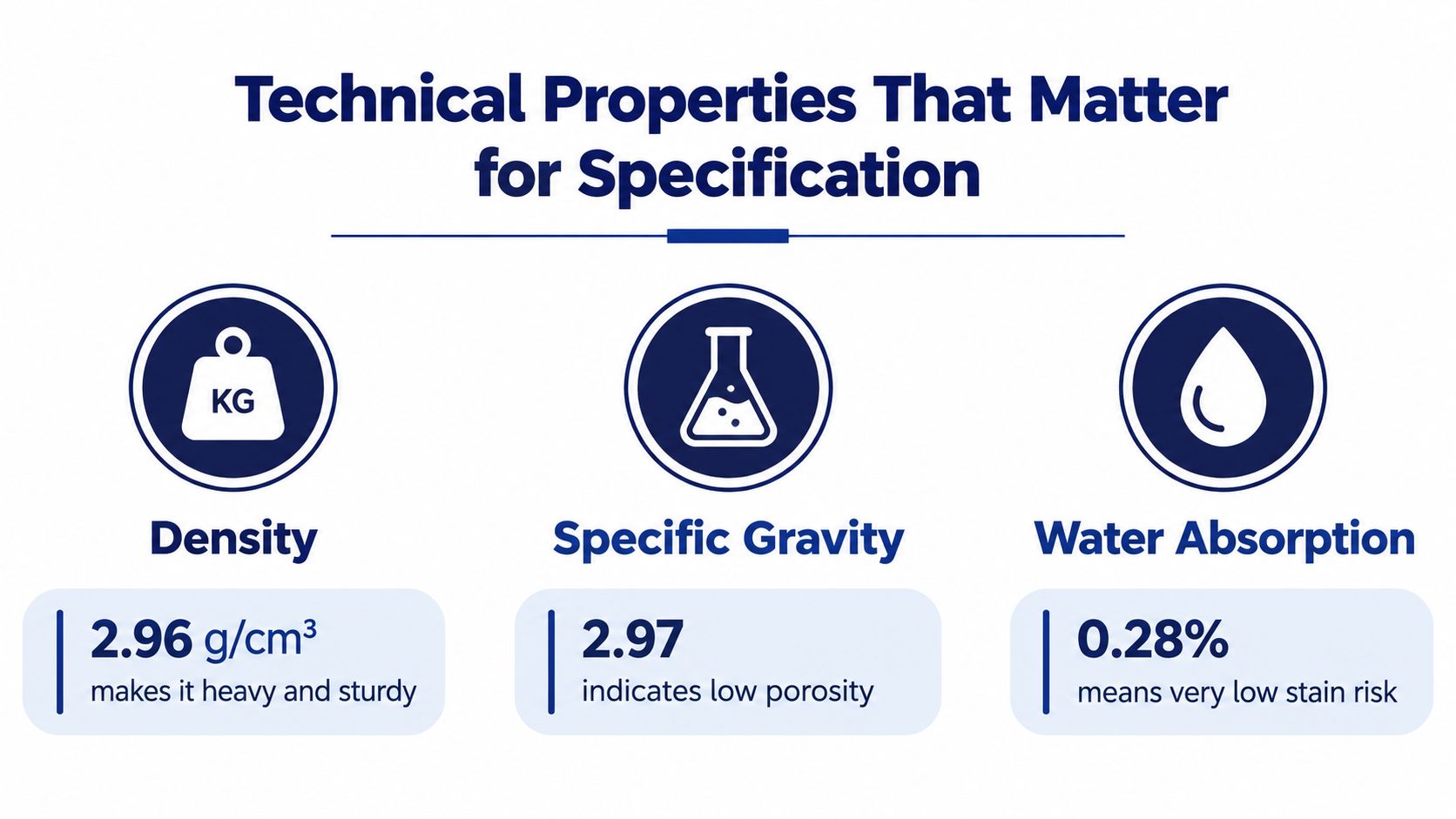
A practical reading of trade data and standards references places Desert Green at bulk specific gravity around 2.60 to 2.63 g/cm³ and water absorption around 0.37 to 0.50%, which sits close to the BIS benchmark for structural granite of minimum specific gravity 2.6 and maximum water absorption 0.5% in the BIS standard for structural granite requirements.
What those numbers mean on site
Specific gravity is a compactness check. In plain terms, it helps you judge whether the stone behaves like a dense structural material rather than a more open decorative surface. Fabricators read that together with slab size, span, and edge detail before finalising support and handling.
Water absorption is the number many homeowners overlook and many architects should ask about earlier. Lower absorption usually means fewer microscopic routes for moisture to enter the stone. That matters in kitchens, bathroom thresholds, lift lobbies, and exterior cladding details where wetting and drying repeat over time.
A simple analogy helps here. Low absorption in stone works like a tightly woven fabric in rain. Water still sits on the surface, but it has fewer easy paths inward.
Why BIS alignment matters during specification
BIS alignment gives NCR architects, contractors, and procurement teams a shared reference point. It does not replace project-specific testing, but it gives you a sensible filter before you compare rates across yards and suppliers.
That matters because Desert Green often sits in an economically useful middle band. Quartz usually gives tighter visual uniformity and easier expectation-setting for clients who want every counter to match closely. Premium granites can offer stronger exclusivity or dramatic movement, but they often raise material cost and replacement risk. Desert Green makes sense when you need natural stone performance, outdoor compatibility, and a controlled budget without stepping into the rarer granite bracket.
Use the numbers this way:
| Property | Why you care | Practical reading for Desert Green |
|---|---|---|
| Specific gravity | Affects weight, handling, and suitability for structural applications | Typically sits near the BIS benchmark used for structural granite checks |
| Water absorption | Affects moisture entry, staining risk, and weather-exposed behaviour | Usually low enough for common counter, floor, and façade applications |
| Thickness confirmation | Affects edge profile, dead load, fixing details, and fabrication planning | Confirm slab and tile thickness from the supplier before cutting approvals |
Thickness deserves one extra note. Do not assume the same nominal thickness across every lot, especially in mixed orders for counters, risers, and window sills. In NCR supply chains, that small mismatch can affect edge alignment, polishing depth, and installation speed more than buyers expect.
What this means in real specifications
For kitchens, Desert Green can be a sound choice if the client wants natural variation and the project does not demand quartz-like colour consistency. For exterior or semi-exterior use, it often makes more sense than quartz because UV exposure and heat are part of the discussion from day one. For prestige interiors where the design depends on rare patterning, a premium granite may still justify its higher rate.
That is the trade-off. Desert Green is usually chosen for balanced performance and cost, not for rarity alone.
Practical rule: ask for test alignment, actual thickness, and finish-approved samples before approving edge details or issuing final quantities.
Commercial teams should also place stone decisions inside the wider capex picture. The article on budgeting for office construction 2026 is useful for understanding how finish selections affect total project cost, not just the stone line item. If you are comparing Indian stone categories more broadly, this guide to signature marble and granite selection across Indian projects provides helpful context.
Finishes and How They Change Look and Performance
The same Desert Green slab can look noticeably different once the finish changes. Buyers often focus on colour first, then treat finish as a minor add-on. On site, finish changes both the appearance and how the surface behaves under shoes, water, touch, and cleaning.
What each finish does to the stone
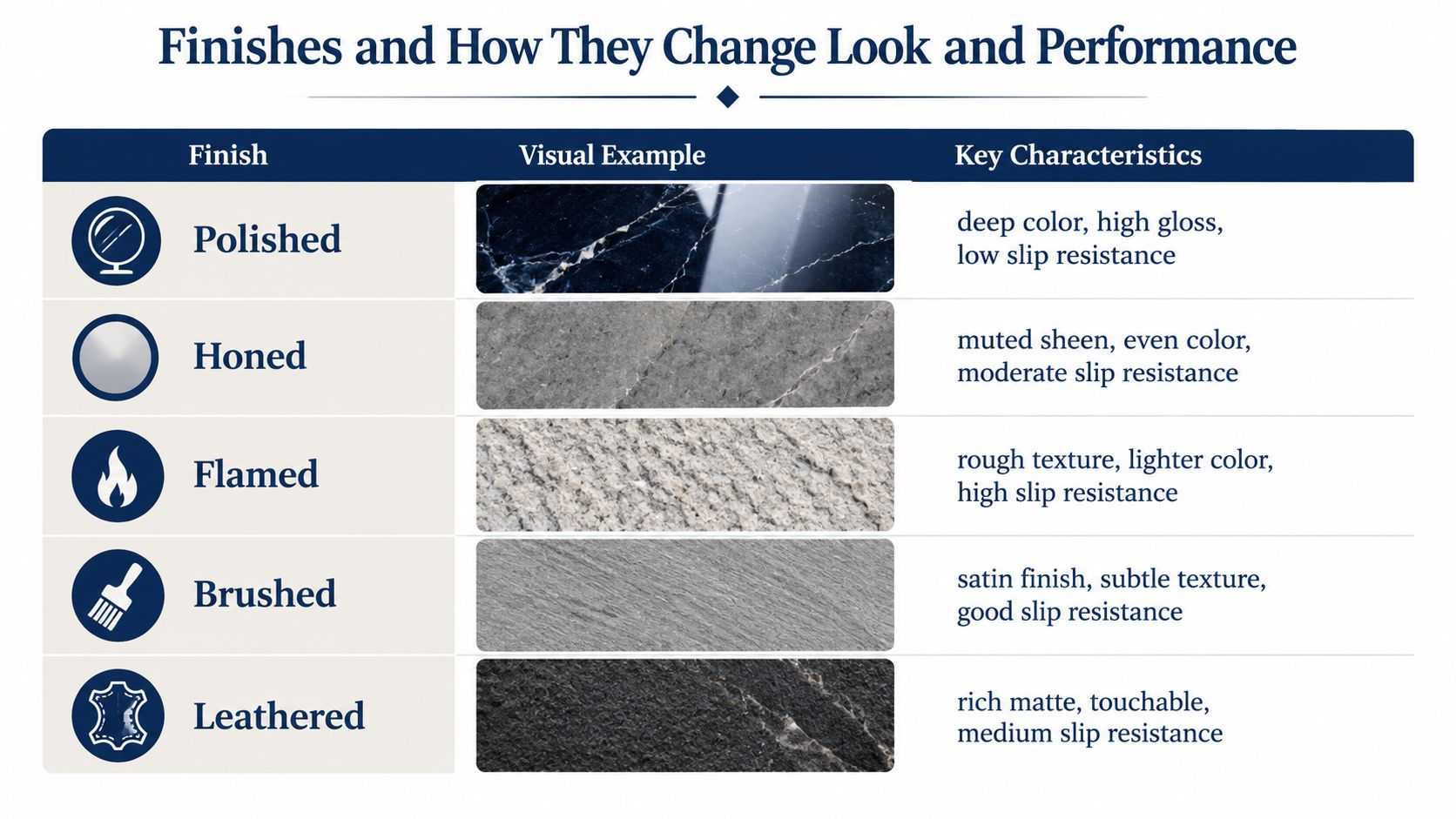
A polished finish usually deepens the colour and sharpens mineral contrast. If you want the green-grey base to read richer and more defined, polished is often the version people respond to first in a slab yard.
A honed finish softens reflection. The stone still reads elegant, but in a quieter way. This can help where glare is a concern or where you want the flooring to feel more architectural and less glossy.
Flamed finishes roughen the surface and often lighten the apparent tone. That makes them useful where slip resistance matters more than colour depth.
Brushed and leathered finishes sit in the middle. They preserve some richness while adding texture and a more tactile, matte character.
For readers comparing hardscape finishes more broadly, especially in exterior contexts, this guide on how to choose a stamped concrete finish is useful because it shows how texture choices change both look and underfoot performance across materials.
Quick comparison for decision-making
| Finish | Best use | What you gain | What to watch |
|---|---|---|---|
| Polished | Kitchen tops, feature counters, wall panels | Strong colour depth and easy wipe-clean surface | More visible smudges, less grip underfoot |
| Honed | Indoor floors, bathroom counters, minimal interiors | Softer look, reduced glare | Can show wear patterns differently than polished |
| Flamed | Exterior paving, steps, wet entries | Better texture for grip | Colour appears lighter and rougher |
| Brushed | Transitional flooring, staircase treads | Gentle texture and relaxed finish | Needs sample approval because texture varies |
| Leathered | Countertops and statement surfaces | Matte richness and tactile surface | Not every batch responds identically to texturing |
A short visual reference helps if you're comparing surface treatments in motion:
Matching finish to lifestyle
If the kitchen is busy and the family wipes surfaces often, polished usually makes sense. If the floor sees frequent foot traffic and you don't want every mark highlighted by light reflection, honed or brushed often feels calmer.
For stairs and outdoor transitions, choose grip first and beauty second. People forgive a slightly lighter finish. They don't forgive a slippery tread.
Where Desert Green Works Best and Where to Think Twice
Desert Green works best when you need durability, repeatability, and a grounded natural look without paying for a highly dramatic feature stone. It's especially useful when one material must cover several functions in the same project.
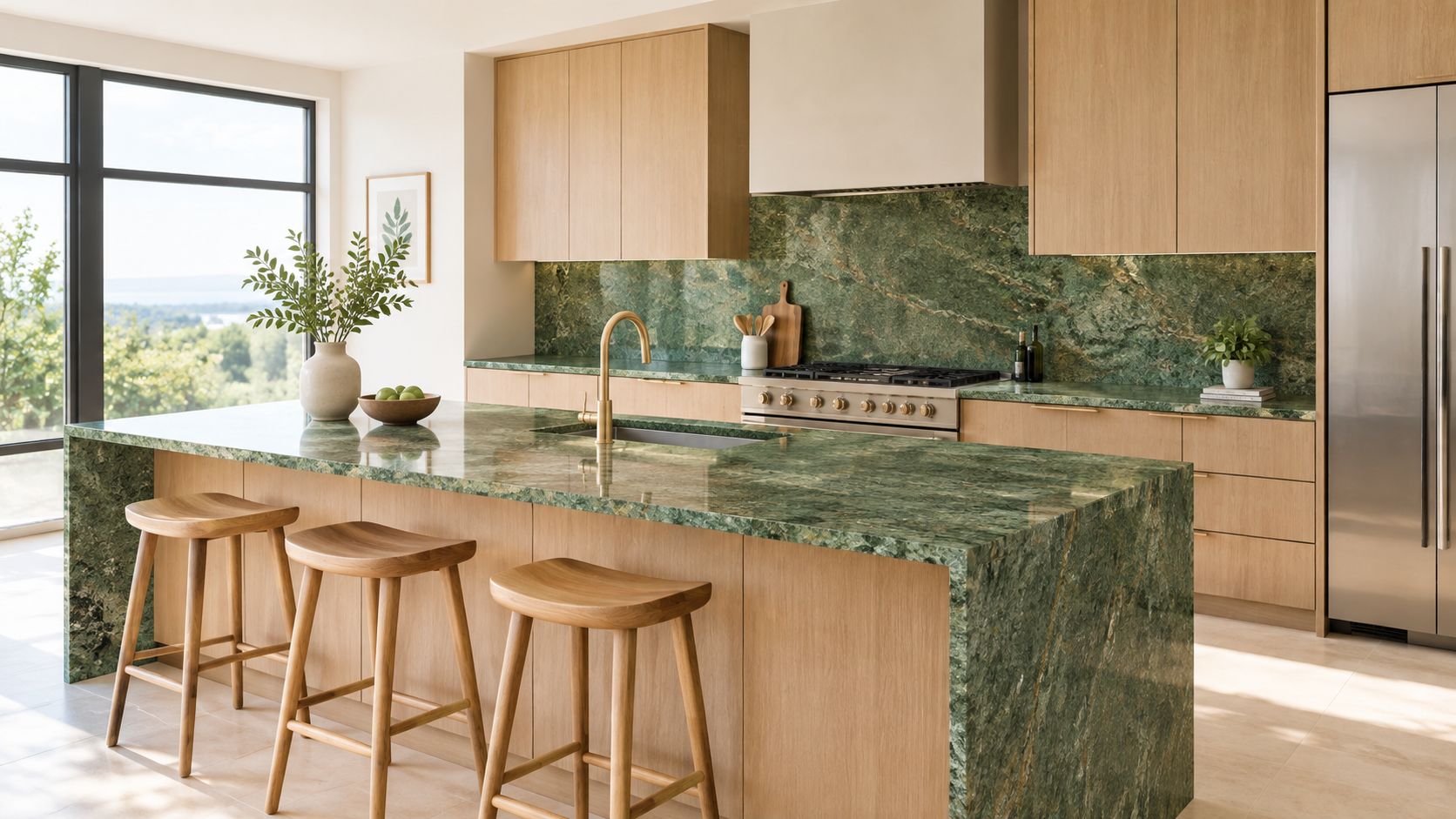
Good uses for Desert Green granite
Kitchen countertops are one of the strongest fits. The colour hides everyday crumbs and light dust better than very pale surfaces, and the natural variation is forgiving in lived-in homes.
Flooring is another sensible application, especially where you need a darker neutral that won't feel black or too formal. In commercial areas, it can support a practical, repetitive palette.
Stair treads and risers also suit the material, especially in honed, brushed, or flamed versions depending on location. The pattern is busy enough to avoid looking bland, but not so dramatic that each tread feels visually chaotic.
Wall cladding and façade work can make sense where a natural Indian granite is preferred over composite products. The stone's low-absorption profile is part of why it is commonly considered for such uses in practical specification discussions.
Where you may want another material
Desert Green may not be the right choice if the design brief depends on very high visual consistency. Natural stone varies. If a client expects every section of the kitchen to look almost printed and uniform, quartz is usually easier to control.
It may also be the wrong choice if the brief calls for a premium “hero slab” with dramatic veining. Desert Green generally reads as a dependable workhorse, not a theatrical centrepiece.
Desert Green versus quartz and premium granites
Buyers often get stuck here, so here's the clearest way to consider it.
- Choose Desert Green granite when you want natural stone character, broad application flexibility, and sensible project economics.
- Choose quartz when visual consistency, easy repeatability, and a more controlled pattern matter more than natural variation.
- Choose a premium granite when the slab itself must become the focal design element.
The market language around Desert Green often calls it “low maintenance” or “very hard”, but many listings still stop short of giving India-specific lifecycle comparisons against engineered surfaces. That's why the smarter comparison is functional, not emotional. If the project values natural stone authenticity and heavy use, Desert Green often earns its place. If the project values absolute consistency and a manufactured look, quartz may be the cleaner answer.
Three real-world selection snapshots
A home kitchen often benefits from Desert Green when cabinetry is warm wood, cream, taupe, or muted white. The stone gives enough contrast without making the room feel severe.
An office pantry or reception floor can use it well when the brief needs durability and repeatability rather than luxury theatrics.
A hospitality project should pause and sample carefully. In some venues, Desert Green fits back-of-house counters, corridor flooring, or service zones better than the main visual feature areas.
How to Source Select and Specify Desert Green Granite in NCR
A common NCR mistake happens before cutting starts. The client approves a hand sample, the contractor orders by stone name, and the installed surface arrives darker, busier, or flatter than expected. Desert Green usually performs well, but procurement gets risky when "same material" is treated as "same appearance."
The safer approach is to specify it the way you would specify wood veneer. Species alone is not enough. You also control shade range, finish, thickness, and which face becomes visible in the final installation.
Start by fixing the use case. A kitchen counter, lift lobby floor, exterior step, and wall cladding panel may all use Desert Green, but they should not be bought with the same approval logic. The finish affects slip, glare, maintenance effort, and even how much of the grain you notice under NCR lighting conditions.
Then inspect full slabs. Small chips are useful for color direction, but they hide the full story. On a full slab you can judge tonal drift, mineral concentration, dark patches, and whether adjacent pieces belong to a batch that will read as one family after installation.
Thickness should be decided at the same time as edge treatment and support planning. A 20 mm slab with a simple eased edge gives one result. A thicker build-up edge creates a heavier visual line and changes fabrication details, especially at islands, vanity fronts, and stair treads.
What to check at the yard or showroom
In NCR, sourcing often moves quickly because buyers compare several stones in a single visit. Slow that part down. View the actual slabs under light that is close to the project condition, and ask the yard to place candidate slabs side by side. Desert Green can shift from muted olive to deeper bottle-green depending on polish level, resin fill, and surrounding light.
Varun Marbles operates showrooms in Sikanderpur Marble Market and HUDA Marble Market Sector 33-34. For buyers, that matters less as a marketing point and more as a process point. You can inspect slabs in person, compare finish options, and tag the exact pieces approved for fabrication.
If the project palette is still undecided, a cooler comparison stone can sharpen the decision. Reviewing a slab such as Sky Blue granite beside Desert Green often makes the undertone difference easier to read than looking at either stone alone.
What a good specification should say
For tendering and purchase approval, "Desert Green granite" is too loose on its own. A better specification names the material and the acceptance limits.
Include these points before release for cutting:
- Application and location: countertop, flooring, riser, tread, cladding, sill, or vanity
- Finish: polished, honed, flamed, leathered, or another approved finish sample
- Thickness: state nominal thickness and acceptable tolerance as per supplier capability and project requirement
- Shade approval: approved from full slabs, not brochure chips
- Batch control: all visible adjoining pieces to come from the same approved lot where possible
- Face marking: identify top face, directional grain preference, and exposed edges
- Edge profile: approve on a sample piece before production
- Extra quantity: allow for selection, breakage, site cutting, and future replacement stock
- Installation readiness: coordinate templating, cut-outs, access, and lifting sequence before dispatch
For commercial work, also ask whether the supplier can align documentation and supply practice with relevant BIS expectations for dimension, finish consistency, and stone identification. Even when the project team does not write a highly technical stone schedule, this level of discipline reduces site disputes.
NCR sourcing and cost judgment
Desert Green often makes economic sense in NCR because it sits in a practical middle band. You get a natural stone surface with broader visual character than quartz and without stepping into the cost territory of premium statement granites. That does not mean "buy the cheapest lot." It means buying the right lot for the right use.
For example, a back-painted kitchen with controlled lighting may justify paying more for tighter slab matching on the main island while accepting slightly more variation on utility counters. A builder floor lobby may do the reverse and spend more on finish uniformity and edge quality than on rare pattern selection. Good sourcing is mostly about putting money where the eye and wear will notice it.
Budgeting should also separate stone price from delivered-and-installed cost. This reference on DG installed pricing for properties covers a different material, but the lesson is useful. Material rate, transport, cutting loss, edge work, polishing, lifting, and site conditions all change the final number.
Approve the actual slabs, tag them, and make those tags follow the stone to the cutting shop. That one step prevents many of the surprises people wrongly blame on the material itself.
Maintenance Sealing and Long Term Care Made Simple
Desert Green granite doesn't need fussy daily treatment, but it does reward sensible care. The goal isn't to over-maintain it. The goal is to keep the surface looking stable and clean without slowly dulling the finish through bad habits.
The easy routine that works
For day-to-day cleaning, use a soft cloth or mop with a stone-safe cleaner and plain water as needed. In kitchens, wipe spills early instead of waiting for them to sit around oils, pigments, or food acids.
Sealing should be treated as a practical check, not a ritual obsession. Granite with low absorption often won't need the same anxiety buyers bring to softer stones, but a site-specific sealing plan still makes sense based on finish, use, and installer guidance.
What usually causes avoidable damage
Most wear comes from the wrong products, not from normal use.
- Acidic cleaners: These can affect the surface finish over time.
- Abrasive pads: They may leave micro-scratches or dull polished areas.
- Standing grime: Dirt underfoot acts like a fine abrasive on flooring.
- Ignoring small issues: A minor dull patch is easier to address early than after broad wear develops.
Simple troubleshooting
If a countertop loses some shine in one patch, first ask whether it's a residue problem or an actual finish change. Many apparent “stains” are surface films from cleaners or hard-water deposits, not deep stone damage.
For floors, the first maintenance upgrade is often procedural rather than chemical. Better entrance matting, more frequent dust removal, and the right mop routine usually matter more than stronger cleaning agents.
A durable stone still needs disciplined housekeeping. Durability doesn't mean neglect-proof.
Desert Green delivers the best long-term value when the application suits the finish, the slab batch is selected carefully, and the maintenance routine stays simple.
If you're comparing Desert Green granite with quartz, marble, or other Indian granites for a home or commercial project, Varun Marbles can help you review full slabs, finishes, thickness options, and fabrication details in Gurugram. You can visit Varun Marbles to explore natural stone and engineered surface options with selection support that connects the yard decision to the site installation.