
China Mosaic Flooring Design: Expert Guide for 2026

China mosaic flooring design isn't a decorative exercise. Its strongest applications connect cultural reference with material behaviour, room scale, foot traffic, moisture, cleaning routines, fabrication accuracy and installation skill. The tradition itself reflects that complexity. Ceramic-tile knowledge travelled from China through Central Asia and Turkey into India during the Sultanate period, later becoming established in Mughal-era cities including Delhi and Lahore, with glazed tile work continuing in imperial commissions during the reigns of Jahangir and Shahjahan. This documented trans-Asian history makes the material especially relevant to Indian interiors today.
The gallery below organises seven project-ready directions by design intent and performance. You'll find blue-and-white porcelain references, natural marble inlay, quartz and granite for demanding commercial areas, illuminated onyx, terrazzo-style composites, imperial reproductions and contemporary mixed-stone geometry. Use these mosaic tile design ideas as a starting point, then evaluate actual slabs, finishes, mock-ups and installation constraints before approving a pattern. Varun Marbles can support that process through curated stone selection, showroom review, fabrication and installation coordination in Gurugram.
Table of Contents
- 1. Traditional Chinese Blue and White Porcelain Mosaic
- 2. Geometric Marble Inlay Mosaic with Natural Veining
- 3. Granite and Quartz Composite Mosaic for High-Traffic Commercial Spaces
- 4. Onyx Translucent Mosaic with Backlit Feature Patterns
- 5. Terrazzo-Style Composite Mosaic with Aggregate and Natural Stone Flecks
- 6. Ancient Chinese Pattern Marble Mosaic
- 7. Contemporary Abstract Geometric Mosaic with Mixed Natural and Engineered Stone
- 7-Style China Mosaic Flooring Comparison
- Turn the Gallery into a Flooring Specification
1. Traditional Chinese Blue and White Porcelain Mosaic
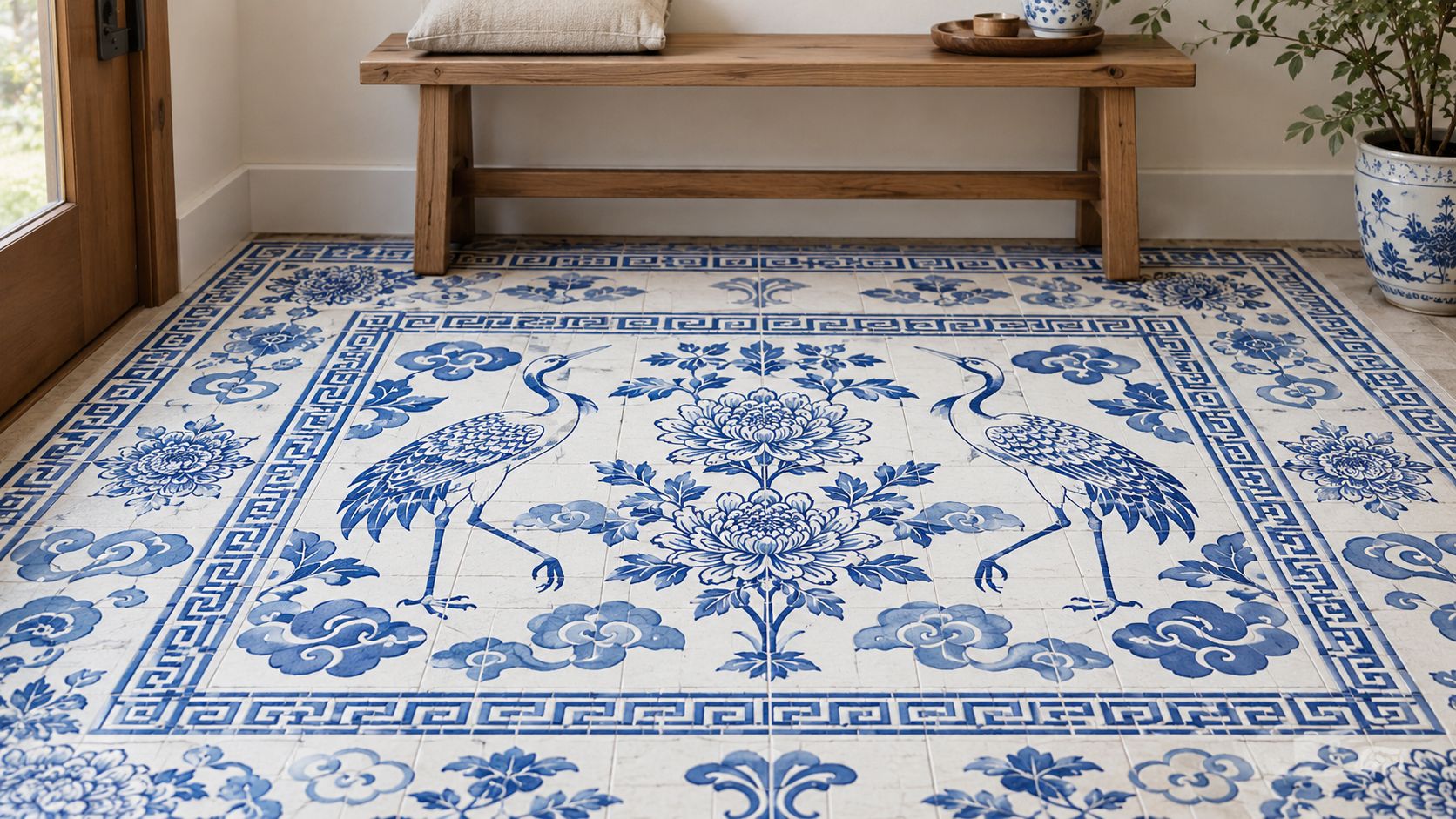
Blue and white porcelain delivers the clearest visual connection to classical Chinese ceramic art. Hand-painted motifs or digitally reproduced surfaces can combine cranes, floral compositions, cloud forms and disciplined geometric borders, creating a floor that reads as cultural reference rather than generic ornament.
The pattern works particularly well in a restrained room. A premium bathroom, spa reception, Chinese restaurant or hospitality lounge can use the design as a concentrated focal surface, while neutral walls and simple furniture prevent the floor from competing with every other finish. A residential project rarely needs the pattern throughout the entire home. One entry zone, powder room or feature wall often gives the strongest result.
Choose the surface for the workload
Glazed ceramic preserves the traditional visual language, but the finish needs careful evaluation in wet areas. A glossy surface can become difficult underfoot when exposed to water, so specify a suitable anti-slip treatment or choose a product with verified slip performance for the intended application. Engineered quartz with a printed decorative surface can provide a more consistent appearance and may simplify maintenance in demanding settings, but it won't reproduce the irregular character of hand-painted ceramic in the same way.
Practical rule: Treat the pattern as a focal material, not as background decoration. The more detailed the motif, the more carefully you should control surrounding colours and furnishings.
Fabrication planning matters because repeated floral or geometric elements must align across sheets, borders and corners. Ask the fabricator to prepare a layout drawing and confirm the installation sequence before cutting begins. Designers comparing blue-and-white stone references can also review blue and white marble guidance when deciding whether the final effect should come from ceramic imagery or natural veining.
2. Geometric Marble Inlay Mosaic with Natural Veining
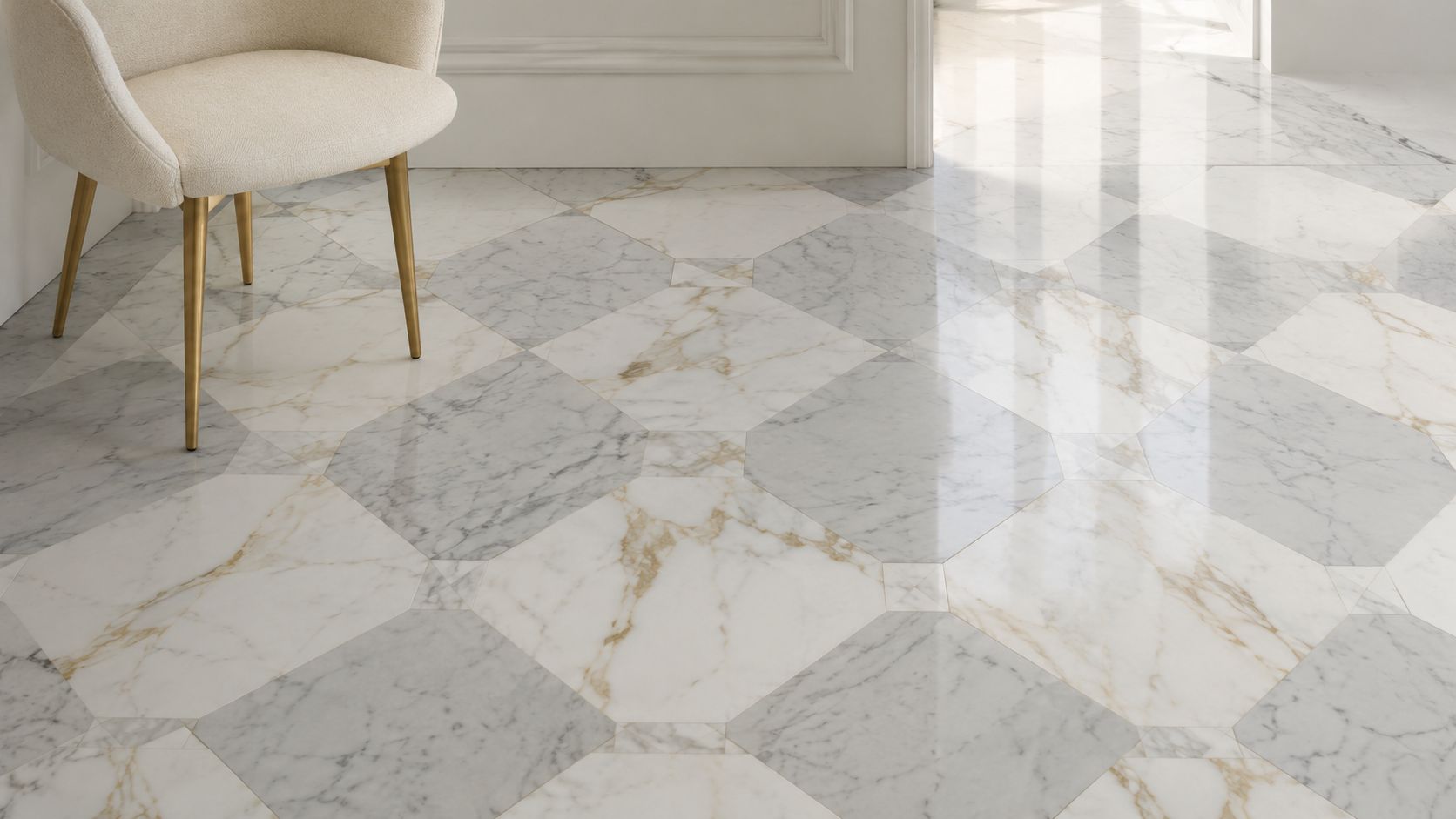
Natural marble inlay replaces printed imagery with the material's own colour, tone and veining. Diamonds, hexagons, chevrons and interlocking shapes become a study in cutting accuracy, slab selection and joint control. The result can feel historically informed while still fitting a contemporary penthouse, hotel lobby or formal residence.
This approach suits projects where the floor needs to carry architectural presence without relying on a busy surface print. White marble with grey veining can establish a quiet base, while darker marble or contrasting Indian stone defines borders and geometric inserts. The same pattern can feel formal in a lobby and intimate in a smaller residential room, but the layout should be scaled to the space rather than copied from a reference image.
Control the stone before cutting
Natural slabs vary. A sample tile rarely tells you enough about how veins will travel through a complete floor, so review full slabs in person or approve a carefully prepared slab map. The designer and fabricator should mark which sections will form the principal shapes, where book-matching is useful and how colour variation will be distributed.
Digital drawings are valuable, but they don't replace a dry layout. Place the cut pieces before permanent installation, particularly where a central medallion, border or directional vein is part of the design.
- Use a honed surface in busy zones: It generally presents less glare and can feel more controlled underfoot than a highly polished surface.
- Specify the sealing system early: Marble remains vulnerable to staining and chemical damage if the cleaning and sealing regime is poorly matched to the stone.
- Set tolerance expectations: Pattern edges, corners and joints need an agreed installation tolerance, not a vague promise of precision.
- Protect the completed floor: Other trades can scratch or stain the surface before handover if the installation team doesn't cover it properly.
A Mumbai penthouse might use a restrained diamond border at the entrance, while a hotel lobby could extend the geometry across a larger field. The design succeeds when the fabricator, mason and site team treat the pattern as a coordinated drawing rather than a collection of loose pieces.
3. Granite and Quartz Composite Mosaic for High-Traffic Commercial Spaces
A hotel lobby, shopping atrium or corporate reception needs more than a memorable pattern. It also needs a surface that cleaning teams can maintain repeatedly, that can tolerate concentrated foot traffic and that won't make every mark visually obvious. Combining engineered quartz with granite inserts creates a useful balance between controlled colour and natural stone character.
Quartz can establish the main field in warm white, beige or grey, while charcoal granite forms borders, corner accents or directional bands. This arrangement gives the floor a luxury language without forcing the entire surface into a high-contrast composition. A corporate headquarters in the NCR, for example, might use a restrained geometric frame around a reception desk rather than a full decorative floor.
Build the pattern around operations
Commercial flooring should be designed with the facility manager in the room. A pattern that looks excellent in a render may create awkward cuts at lift thresholds, door swings, service routes or changes in level. Align the principal geometry with circulation lines and make sure replacement pieces can be identified if local repairs are ever required.
Choose a matte or low-glare finish where reflected lighting could affect comfort or visibility. Quartz is described by Varun Marbles as non-porous and scratch-resistant, with polished, matte and leathered finishes available through its quartz slab collection. Granite adds a different visual and tactile note, but it still needs a cleaning specification that avoids unsuitable chemicals and abrasive procedures.
A commercial mosaic should look intentional after a busy day, not only after the final polish.
Before approval, request finish samples under the actual project lighting. Also ask for slip-resistance information appropriate to the building's use, especially near entrances, bars, wash areas and hospitality kitchens. The best result is not necessarily the most intricate pattern. It's the one that maintains clear circulation, manageable cleaning and visual identity without turning every junction into a fabrication problem.
4. Onyx Translucent Mosaic with Backlit Feature Patterns
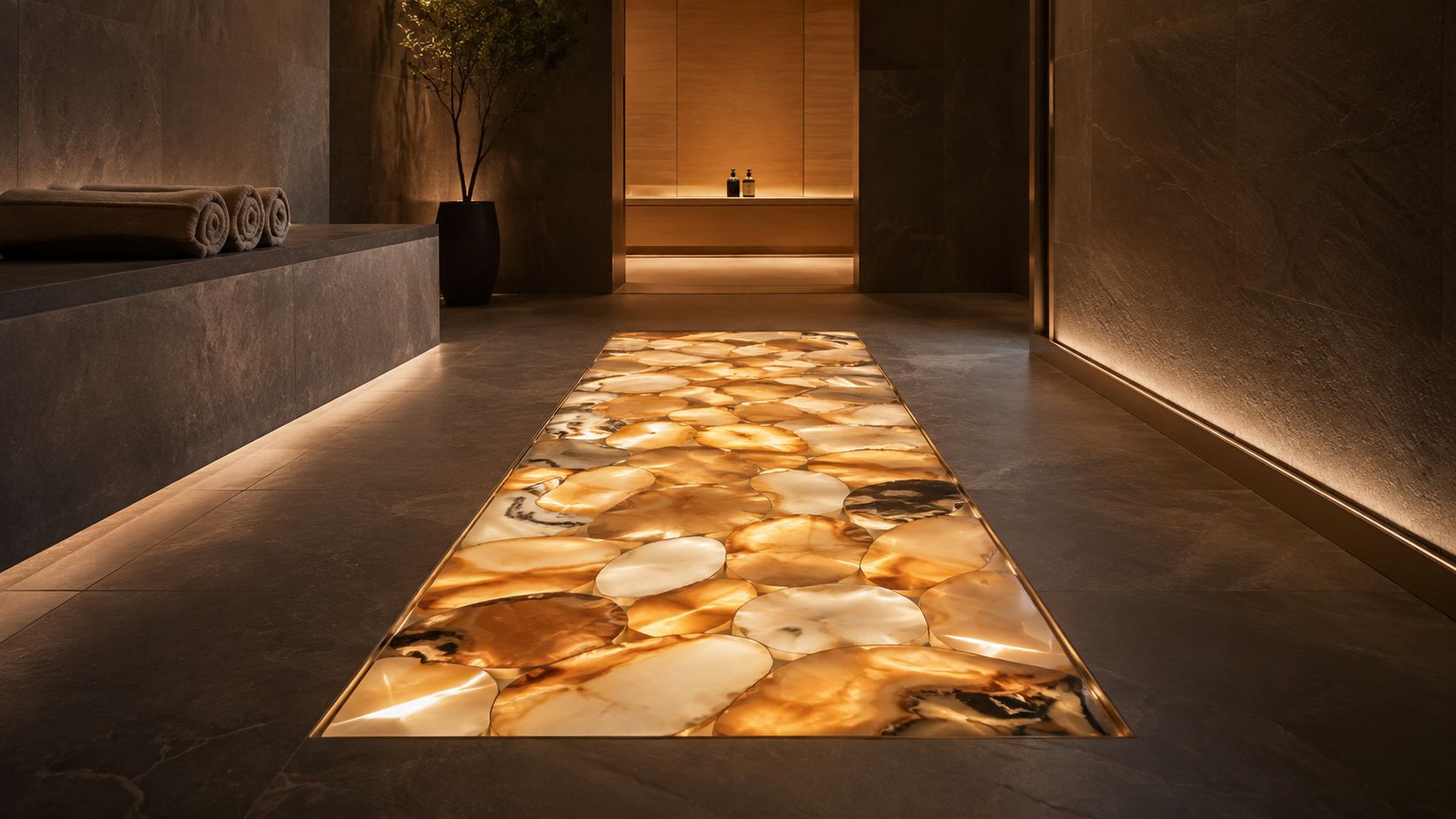
Onyx changes the role of mosaic from surface decoration to controlled illumination. Thin natural pieces can be arranged over a prepared backing and lit from behind, allowing colour variation, translucency and vein movement to become part of the interior lighting scheme. Amber, honey, cream and soft green tones can create a warm feature in a lounge, spa, private dining room or luxury bathroom.
The material is most effective where people can pause and see it. A backlit onyx floor in a primary circulation route faces greater risk from impact, abrasion, dirt and replacement difficulty than an onyx panel in a wall, bar front or low-traffic threshold. For that reason, many projects should reserve the material for an accent zone rather than use it as the main walking surface.
Design the light and stone together
A lighting designer should be involved before the stone is cut. LEDs, access panels, heat management, wiring routes and the backing structure all affect the final appearance. Uneven light can exaggerate seams or create bright spots, while a carefully planned radial pattern or tonal gradient can make the mosaic appear deeper and more coherent.
Onyx is softer and more chemically sensitive than many granite or quartz options. Protect exposed edges during transport and installation, use suitable neutral cleaning products and keep acidic cleaners away from the finished surface. A fabricator should also confirm how the pieces will be supported, particularly where the installation sits on a wall, bar front or suspended architectural element.
See how onyx marble texture can influence the visual reading of a feature installation before choosing the lighting temperature and pattern direction.
The practical decision is simple. Use onyx where its translucency earns its place, and select a more durable material for the surrounding floor. A dark granite frame, neutral marble field or matte quartz transition can protect the feature visually while reducing the amount of delicate material exposed to daily wear.
5. Terrazzo-Style Composite Mosaic with Aggregate and Natural Stone Flecks
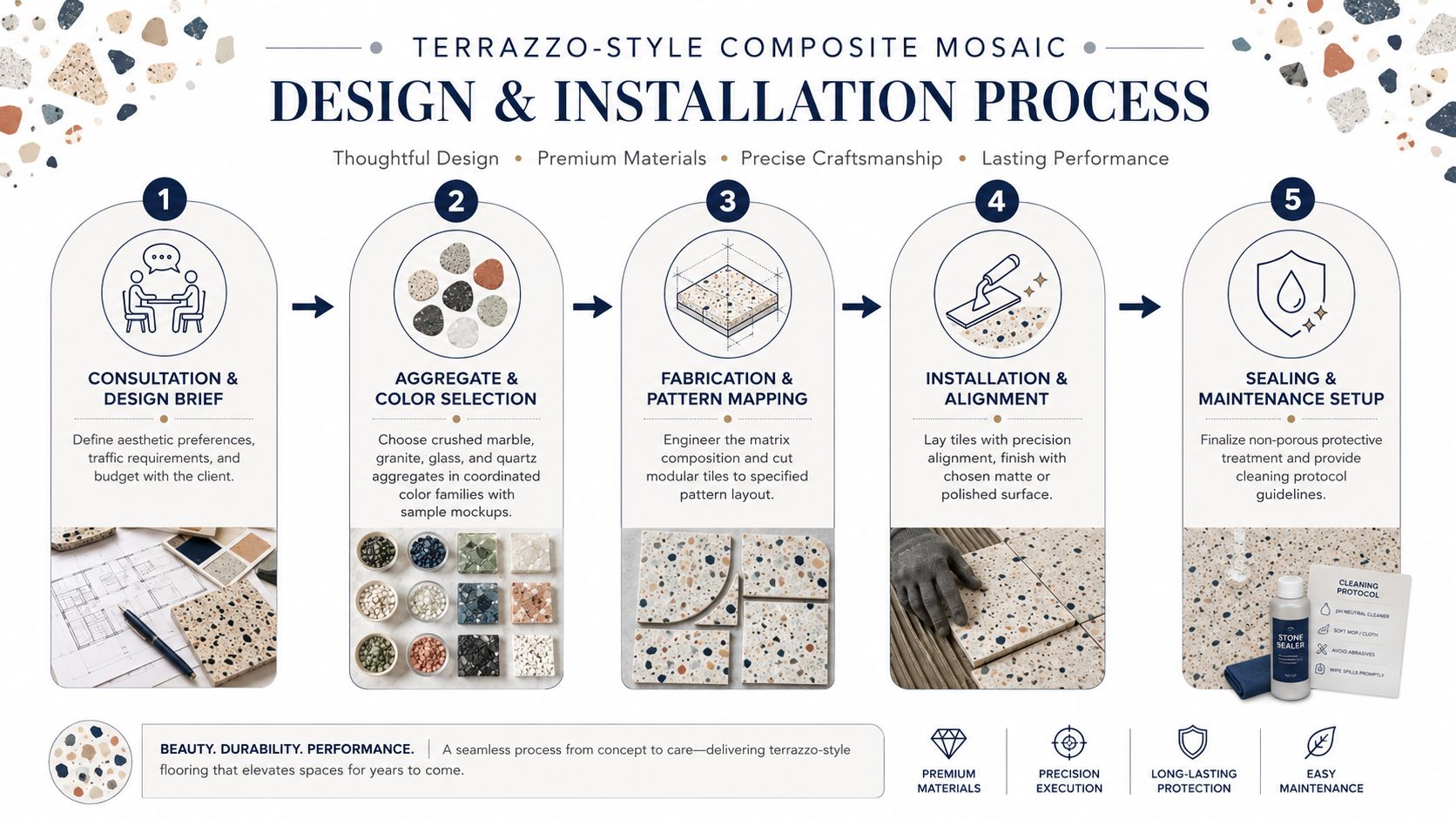
Terrazzo-style mosaic creates a calmer, more continuous field than individually prominent stone pieces. Crushed marble, granite, glass and other aggregates are embedded in cementitious, engineered or resin-based matrices, then polished or honed to reveal the flecks. Borders, bands and abstract inserts can define circulation zones without turning every joint into the visual focus.
For Indian residential and commercial projects, select the mix around the site rather than the trend. Controlled whites, greys, blacks, terracotta tones and muted greens can connect Chinese-inspired references with contemporary interiors. A reception floor with a contrasting border provides structure without requiring a figurative motif. The same approach suits boutique hotels, apartment common areas, offices, retail interiors and wellness spaces.
Resolve moisture, fabrication and maintenance before approval
Cement terrazzo is porous and should be sealed to reduce water and stain absorption, as noted in India-focused terrazzo guidance. In bathrooms, kitchens, balconies and semi-outdoor areas, confirm the substrate, falls, joint layout and surface treatment before fabrication. Resin or engineered options can simplify some maintenance, but the specification still needs to address slip behaviour, UV exposure, cleaning chemicals and localised repairs.
Aggregate size and distribution affect both appearance and serviceability. A dense, fine mix can read more evenly and disguise minor scuffs, while larger flecks create stronger visual movement but make patching more apparent. Request a full-size sample, not only a small tile, because polishing, aggregate concentration and grout alignment change the finished reading.
Existing floors also warrant assessment before removal. Restoration is listed at roughly ₹40 to ₹90 per sq ft, while newly poured-and-polished in-situ marble-chip mosaic is listed at roughly ₹100 to ₹180 per sq ft in a 2026 India-based guide. The restoration and new-installation comparison illustrates why condition, access and repair scope should be reviewed before demolition.
- For a busy lobby: Choose a dense aggregate mix and a finish that limits visible scuffs.
- For a residence: Allow custom colour and inserts, while keeping future furniture changes in mind.
- For a wet area: Approve sealing, slope, joints and slip performance as one package.
6. Ancient Chinese Pattern Marble Mosaic
Imperial Chinese references demand more discipline than adding a dragon motif to a floor. Reproductions inspired by the Forbidden City, the Summer Palace or Ming-era residences need proportion, symbolism, border logic and material selection to work together. Cloud scrolls, dragons, phoenixes, symbolic animals and fretwork can be rendered in precisely fitted marble pieces, but a generic pattern may look decorative without feeling authentic.
The right setting is one that can carry cultural specificity. A museum, Chinese cultural centre, private club, heritage-led hospitality project or ultra-luxury residence can justify a more formal composition. In a smaller room, a simplified border or central emblem may be stronger than an overfilled scene that loses clarity at walking distance.
Treat authenticity as a technical brief
Begin with archival references and a written design intent. Identify which motifs are historically appropriate, which colours are being interpreted for contemporary use and whether the project is a reproduction, an adaptation or an original design influenced by Chinese imperial architecture. That distinction prevents the final floor from making claims it cannot support.
Fabrication should involve a stone artisan comfortable with complex inlay. The team needs scaled drawings, material boards, numbered pieces and a dry mock-up. Photographing the installation and recording the approved materials can also help future owners understand how the floor was made and how it should be maintained.
Design discipline matters: Historical patterning becomes convincing when the floor, wall finishes, lighting and furniture share the same cultural vocabulary.
Natural marble brings depth, but it also introduces variation and sealing requirements. A project team should approve the actual slabs, not only a digital colour palette, and should establish how veins will be placed within symbolic shapes. Imperial reproductions are rarely the fastest flooring option, yet their value lies in the crafted result and the sense of continuity they create.
7. Contemporary Abstract Geometric Mosaic with Mixed Natural and Engineered Stone
Abstract geometry gives designers the most freedom to move beyond historical reference. Marble, granite and engineered quartz can combine in chevrons, herringbone layouts, fractured shapes, stepped borders or carefully controlled random mosaics. The visual language suits modern luxury interiors where the floor needs to feel distinctive but not tied to a specific historical motif.
A Gurugram office reception might use charcoal granite and pale quartz to define a directional path, while a Mumbai penthouse could use warm marble with a restrained chevron at the entry. In a premium bathroom, mixed stone can create a smaller feature field that relates to the vanity or wall niche without covering every surface.
Test complexity at full scale
CAD drawings should establish piece sizes, colour distribution, grain direction, edge conditions and transitions before fabrication. A temporary mock-up in the actual room is especially useful because artificial renderings often hide how quickly a pattern becomes dominant under real lighting. Compare the proposed floor against wall tile, joinery, ceiling details and furniture, not against an empty plan.
Material contrast can come from colour, texture or both. Polished marble beside honed granite creates a perceptible shift, but that transition needs careful detailing so it doesn't become a maintenance trap or a trip edge. Matte quartz can provide a calmer field around more expressive natural stone inserts.
- Keep feature areas focused: Entryways, powder rooms and selected corridors can carry stronger geometry than a whole residence.
- Control the palette: Two or three related tones usually integrate more easily than many unrelated stones.
- Align the pattern: Doorways, thresholds and major furniture axes should be considered during the first layout, not adjusted after cutting.
- Approve the surface in context: Natural daylight and artificial lighting can change the apparent contrast between materials.
The strongest contemporary china mosaic flooring design doesn't chase complexity for its own sake. It uses mixed materials to direct movement, frame architecture or establish a memorable arrival experience, while leaving enough visual quiet for the rest of the interior.
7-Style China Mosaic Flooring Comparison
| Design | Implementation Complexity 🔄 | Resource Requirements ⚡ | Expected Outcomes ⭐📊 | Ideal Use Cases | Key Advantages 💡 |
|---|---|---|---|---|---|
| Traditional Chinese Blue and White Porcelain Mosaic | Moderate–High; precise pattern alignment and skilled installation 🔄 | Glazed ceramic or printed quartz; potential imports; anti-slip treatment advised ⚡ | Strong cultural impact; high visual recognition; feature-quality aesthetic ⭐📊 | Entryways, bathrooms, restaurants, heritage-inspired hospitality | Timeless heritage look; high design appeal; quartz option for durability 💡 |
| Geometric Marble Inlay Mosaic with Natural Veining | High; hand-cut pieces, vein-matching and expert masons required 🔄 | Premium Italian/Indian marbles; high material waste; long lead times ⚡ | Unique, high-end luxury finish; long-lasting and authentic marble character ⭐📊 | Luxury residences, five-star lobbies, premium hospitality | Genuine stone prestige; one-of-a-kind veining; museum-quality craftsmanship 💡 |
| Granite and Quartz Composite Mosaic for High-Traffic Commercial Spaces | Moderate; modular tiles simplify layout but require precise grout/joints 🔄 | Engineered quartz + granite inserts; standardised sizes; readily available ⚡ | Durable, stain-resistant, predictable finish; cost-effective in long term ⭐📊 | Hotel lobbies, malls, corporate receptions, healthcare facilities | Non-porous hygiene; low maintenance; faster installation and consistent results 💡 |
| Onyx Translucent Mosaic with Backlit Feature Patterns | Very High; structural supports and integrated lighting demand specialist trades 🔄 | Thin onyx slices, LED systems, custom backing and electrical work; high cost ⚡ | Dramatic backlit ambience; signature luxury focal points; higher ops maintenance ⭐📊 | Low-traffic feature walls, bars, spas, premium residential accents | Unmatched translucency and depth; configurable lighting effects for ambience 💡 |
| Terrazzo-Style Composite Mosaic with Aggregate and Natural Stone Flecks | Low–Moderate; engineered panels or tiles allow simpler installation 🔄 | Engineered quartz or resin matrix with aggregates; custom colour options; faster fabrication ⚡ | Durable, low-maintenance terrazzo look; good cost-to-performance ratio ⭐📊 | Offices, retail, mid/high-end hospitality, residential, medical centres | Cost-effective terrazzo aesthetic; non-porous; highly customisable and fast to deliver 💡 |
| Ancient Chinese Pattern Marble Mosaic (Forbidden City / Ming) | Very High; archival research, 3D mapping and master masons required 🔄 | Multi-colour premium marbles, specialised craftspeople, extended lead times ⚡ | Highest cultural authenticity; prestigious, museum-quality installations ⭐📊 | Museum restorations, ultra-luxury residences, cultural centres | Profound cultural value; exceptional craftsmanship and historical accuracy 💡 |
| Contemporary Abstract Geometric Mosaic with Mixed Stone | High; CAD-led design and mixed-material tolerances demand precise fabrication 🔄 | Mixed marble, granite, engineered quartz; variable waste; skilled fabrication ⚡ | Bold, signature contemporary look; highly customisable; balanced durability ⭐📊 | Boutique hotels, flagship retail, luxury homes, feature zones | Creative flexibility; combines natural beauty with engineered performance 💡 |
Turn the Gallery into a Flooring Specification
Start with the visual reference, but don't stop there. Decide whether the project needs a heritage-led blue-and-white porcelain expression, a bespoke marble inlay, a durable quartz-and-granite composite, a low-maintenance terrazzo-style surface, an illuminated onyx accent, an imperial reproduction or contemporary mixed-stone geometry. The design intent determines how much pattern, variation and craftsmanship the room can support.
Next, match the material to traffic, moisture and cleaning. Quartz and granite composites are logical candidates for demanding commercial zones, while marble inlay rewards projects that can support careful sealing and professional maintenance. Onyx belongs where translucency creates a meaningful feature, not where heavy traffic will quickly undermine its visual and physical advantages. For existing Indian mosaic floors, assess restoration before assuming replacement is the best route. Coastal Goa provides a strong vernacular precedent, where reporting connects china mosaic floors with Macau-Goa maritime trade, ship ballast reuse and families breaking crockery into custom patterns. That Goan account shows how imported fragments became part of local domestic architecture.
Confirm the scale, finish and joint strategy with actual samples. Review a full-size mock-up under project lighting, check how the pattern meets doorways and drains, and verify slip considerations for bathrooms, kitchens, balconies, entrances and semi-outdoor areas. Waterproofing and surface temperature can also be practical design considerations. In a Hyderabad retrofitting project, china mosaic covered one 9,000 sq.m roof across a 10-acre site, with the project report describing waterproofing performance, stated durability of 10 to 15 years and a reported surface temperature decline of 15 to 20°C. The project documentation provides a useful Indian benchmark for heat-oriented roof-surface decisions, though every project still requires its own build-up and site assessment.
Finally, connect design approval to fabrication and installation. Slab selection, cutting files, numbered pieces, dry layouts, substrate preparation, sealing and protection should be coordinated before ordering. Varun Marbles' Gurugram showrooms and yard allow architects, homeowners and contractors to evaluate Italian and Indian marble, granite, engineered quartz and onyx in person, then discuss cut-to-size fabrication, finishing and installation coordination. For broader project inspiration, the Concrete Resurfacing Products project gallery also illustrates why the finished surface should be judged as part of the complete architectural setting, not as an isolated sample.
India's stone flooring market was valued at about $1,022.3 million in 2024 and is projected to reach $1,467.7 million by 2029, according to India stone flooring market projections. That demand makes material discipline more important, not less. A visually impressive floor earns its place when its performance, maintenance plan and installation method are clear from the beginning.
Varun Marbles offers curated engineered quartz and natural stone selections, including Italian and Indian marble, granite and translucent onyx, with slab evaluation, cut-to-size fabrication, finishing and installation coordination. Visit Varun Marbles in Gurugram to review materials and finishes in person, then develop your china mosaic flooring design as one connected selection, fabrication and site-installation workflow.