
Saint Laurent Marble: Complete Buyer's Guide
You're standing in an NCR stone yard with three black slabs in front of you. One has a deep black base with warm brown movement, another looks almost identical under showroom lighting, and the third is labelled “imported black marble”. The prices are far apart, yet the sales explanation is usually the same: premium stone, limited stock, imported origin.
That's where buyers make expensive mistakes. Saint Laurent marble can deliver a dramatic architectural surface, but the name alone doesn't verify its origin, thickness, quality, or installed value. Before approving a slab, you need to assess its pattern, documentation, physical properties, fabrication risk, and suitability for the room.
Table of Contents
- Introduction to Saint Laurent Marble
- Visual Characteristics and Aesthetic Profile
- Quarry Origins and Import Pathways to India
- Recommended Applications and Use Cases
- Finish Options and Surface Treatments
- Slab Selection and Quality Verification
- Pricing, Cost Factors, and Market Positioning
- Fabrication, Installation, and Project Workflow
- Quick Reference Specifications and Standards
- Frequently Asked Questions
Introduction to Saint Laurent Marble
Black marble has a role that lighter stones can't easily replace. It gives a wall, vanity, floor, or counter a strong visual anchor, especially in interiors built around timber, brass, warm lighting, or pale neutral surfaces. Saint Laurent marble is generally marketed in India as an imported natural stone, positioned in the premium slab segment rather than as a thin decorative veneer. An Indian natural-stone catalogue lists it with an 18.00 mm thickness specification and describes uses including floors, walls, and counters (Saint Laurent marble product listing).
Architects usually specify it for controlled areas where the pattern can be seen properly. A bookmatched feature wall, a bathroom vanity with a full front edge, or a carefully selected kitchen island can make better use of this stone than a room covered indiscriminately in dark marble. The reason is simple. The material's value comes from its visual movement, and careless cutting can break that movement into disconnected pieces.
The Indian market still gives buyers limited practical help with authentication. Listings may identify a stone as Saint Laurent without clearly explaining its quarry provenance, block documentation, slab thickness consistency, repair history, or finish performance. That creates confusion between a named imported marble, a similar black marble, and a domestic substitute sold under a broad decorative description.
Consultant's rule: Treat “Saint Laurent” as a material to verify, not as proof of origin.
This guide takes a procurement-first view. You'll learn how to inspect the visual pattern, request supply-chain evidence, apply relevant BIS benchmarks, compare premium pricing with alternatives, and plan fabrication before the slab reaches your site.
Visual Characteristics and Aesthetic Profile
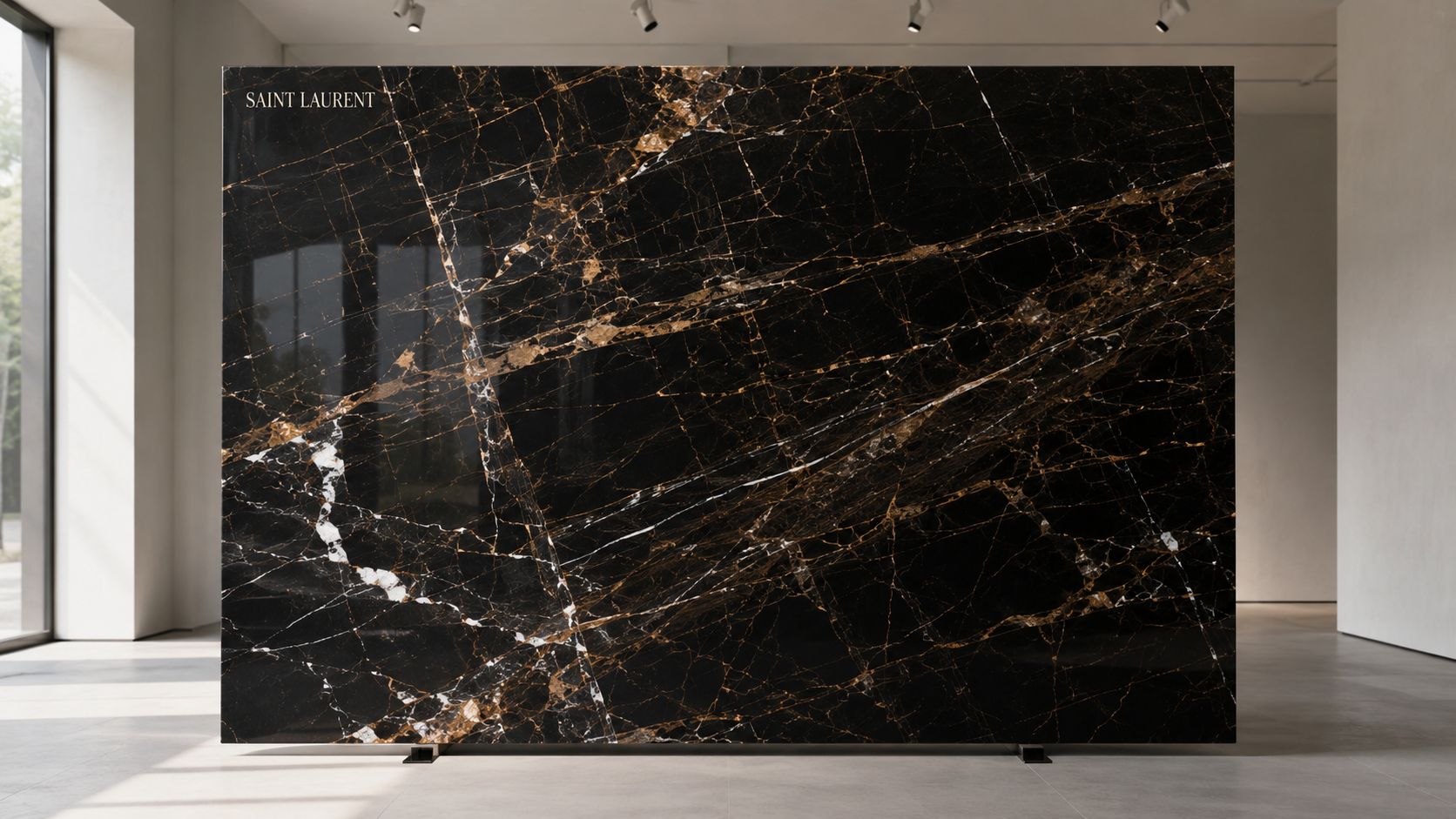
Saint Laurent marble is typically selected for a deep black background crossed by brown, gold, and occasional white veining. The exact movement varies from slab to slab because natural stone is not printed or manufactured to a fixed repeat. A dark base may appear dense and quiet in one section, then open into strong diagonal or branching movement elsewhere.
How to read the pattern
Look beyond the showroom label. Genuine identification should begin with the slab's overall composition, not with a single attractive vein.
- Base colour: The strongest examples present a rich, visually continuous black field. Some natural variation is expected, but large unrelated patches can make a wall look assembled rather than composed.
- Vein character: Brown and gold movement is a defining visual cue. White streaks may appear, but they shouldn't be treated as the only test of identity.
- Direction: Ask whether the veins travel diagonally, vertically, or in a branching network. That direction determines whether the slab will work for a tall wall, horizontal counter, or vanity front.
- Continuity: Place adjacent slabs side by side before cutting. A sequence that looks attractive individually may fail when the veins meet at a joint.
A designer planning a feature wall should reserve the slab layout before fabrication. For bookmatching, two slabs must be opened as a visual pair and checked for reflection, tone, and vein continuation. The result can be striking, but only if the fabricator works from an approved elevation rather than cutting each piece according to the simplest nesting pattern.
Finish and lighting change the reading
A high polish deepens the black field and makes gold movement more reflective. It also reveals fingerprints, water marks, and surface distortion more readily under direct lighting. Honed surfaces soften the reflection and can make the stone feel quieter, while leathered or brushed treatments add tactile variation that may suit a less formal interior.
Warm spotlights can pull out brown and gold tones. Cool white lighting may make the same slab appear harder and can exaggerate pale streaks. Always inspect the actual slab under lighting close to the final installation, particularly for a lobby, bar, bathroom, or living-room wall.
For a broader comparison of how coloured marble is selected for interiors, review this guide to white marble with blue accents. The principle applies here too: approve the physical slab, not just a small sample or catalogue photograph.
Quarry Origins and Import Pathways to India
Saint Laurent is commonly presented in the market as a European black marble, often associated with French or Italian supply channels. That description alone isn't enough for procurement. A showroom may have imported the slab, purchased it through an Indian distributor, or acquired it under a broader black-marble category. The buyer needs a document trail that connects the commercial name to the actual consignment.
India's import market has become more dependent on raw blocks and slabs rather than processed finished products. In Q1 2025, marble import value reached $94.5 million, up 69% year on year, while volume reached 389,678 tons, up 80% (StoneNews report on India's Q1 2025 marble imports). The same report states that 97% of imported volume and 90% of value consisted of raw marble blocks or slabs rather than processed products. That structure increases the importance of local inspection and fabrication control.

Ask for a traceable chain
Use a written request. Don't rely on a verbal statement that the stone is “Italian” or “French”.
- Request the commercial description. The quotation should identify the stone as Saint Laurent or the supplier's exact trade name, along with slab identification and finish.
- Ask about the country of origin. The supplier should distinguish quarry origin from the location of the Indian warehouse or fabricator.
- Match slab markings. Photograph labels, bundle tags, and slab codes before selection. Those identifiers should correspond with the quotation and delivery documentation.
- Review import evidence where available. Bills, packing information, or distributor records may help establish whether the material entered India as a raw slab or through another channel.
- Record the approved slabs. Keep dated photographs showing the full slab, close-ups of veins, and any filled or repaired areas.
India has an active and varied marble import market. Volza reports 16,973 marble shipments into India from June 2024 to May 2025 and includes black rough marble blocks among recent imports (Volza marble import records). Shipment activity demonstrates availability of imported material, but it doesn't authenticate an individual slab. Only matching documentation, physical inspection, and consistent supplier records can do that.
Procurement advice: If a seller won't identify the slab, disclose the stated origin, or provide a written specification, price the stone as an unverified black marble rather than paying a named-stone premium.
Recommended Applications and Use Cases
Saint Laurent marble performs best where appearance matters and the surface can receive sensible maintenance. It's a strong choice for feature walls, vanity fronts, fireplace surrounds, low-to-moderate traffic floors, and selected counters. It's less forgiving when exposed to abrasive traffic, careless chemical cleaning, or uncontrolled outdoor weathering.
Choose the application around the visual return
A feature wall is often the safest high-impact use. The stone remains visible at eye level, joints can be planned around the vein, and the design team can select a polished finish without creating the same slip concerns found on floors. Bookmatched panels work particularly well behind reception desks, in living rooms, and in hospitality settings where the wall is read as a focal composition.
Bathroom vanities are also suitable, provided the fabricator seals and details the surface correctly. Water sitting around tap cut-outs, soap dispensers, or backsplash joints can expose weaknesses in installation and maintenance. The stone itself shouldn't be treated as maintenance-free because it's dense or polished.
Floors and counters require stricter decisions
For residential floors, select areas with controlled traffic and specify a finish that offers practical footing. Entrance zones, lift lobbies, and commercial corridors face a tougher combination of grit, footwear, cleaning chemicals, and repeated movement. A local black stone or granite may deliver better operational value in those conditions, even if Saint Laurent has the stronger decorative appeal.
Kitchen counters demand similar discipline. Marble can react poorly to acids and abrasive cleaning, so the homeowner must accept patina and follow care instructions. If low maintenance is the priority, compare the stone with granite or engineered quartz before approving it. This kitchen marble and granite guide is useful when weighing visual character against worktop practicality.
Avoid using an unverified slab for exterior paving or exposed façades without a project-specific technical review. Freeze-thaw exposure isn't the only concern in NCR. Heat, dust, water ingress, staining, fixing details, and maintenance access all affect the result. A premium interior marble should not be forced into an exterior role because the colour looks impressive.
Finish Options and Surface Treatments
Finish selection changes more than shine. It affects how the black base reads, how visible the veins become, how the surface handles touch, and how confidently it can be used underfoot. Approve the finish on the actual Saint Laurent slab, because a small sample won't show every change in tone or movement.
Polished
A polished finish gives the deepest visual contrast. Brown and gold veins can appear sharper, and the black background may look almost reflective under directional lighting. This is the natural choice for many feature walls, decorative columns, luxury vanities, and carefully protected counters.
The trade-off is visibility. Fingerprints, water spots, dust, and fine scratches are easier to notice on a dark reflective surface. Polished floors can also become a poor choice where water or loose grit is common. Use it for vertical surfaces or controlled areas unless the designer and site team have a clear maintenance plan.
Honed
Honing removes the strong reflection and creates a flatter, softer appearance. The result often suits floors, understated bathrooms, and contemporary spaces where the stone should feel architectural rather than glossy. It can make small surface marks less visually aggressive, although it doesn't remove the need for sealing and careful cleaning.
Leathered and brushed
Leathered and brushed finishes add texture. They can make the material feel warmer and reduce the mirror-like effect of a polished slab, which works well with timber, aged metals, and tactile interiors. The grooves and texture need thorough cleaning, especially on kitchen counters and bathroom surfaces.
Use this decision rule:
- Feature wall: polished when drama and reflection are wanted.
- Residential floor: honed or another approved textured finish, subject to site conditions.
- Vanity: polished for a formal look, honed for a quieter contemporary finish.
- Counter: choose based on stain tolerance, cleaning habits, edge design, and the supplier's treatment recommendation.
Don't assume a textured finish automatically solves slip or maintenance issues. Request a finished sample, inspect the edge, and confirm the proposed sealer before fabrication begins.
Slab Selection and Quality Verification
Slab approval should happen before the cutting list is final. Saint Laurent marble is a pattern-led material, so the cheapest usable slab isn't always the slab that produces the best finished elevation. A small defect in an offcut may be irrelevant, while the same defect through a vanity front or bookmatched wall can ruin the installation.
Indian marble supply is governed by BIS Standard IS 1130:1969, which was reaffirmed under the CED 6 stones committee in 2022. The standard addresses sizes, workmanship, marking, and physical properties for marble blocks, slabs, and tiles (BIS IS 1130:1969 specification).
Run the inspection in this order
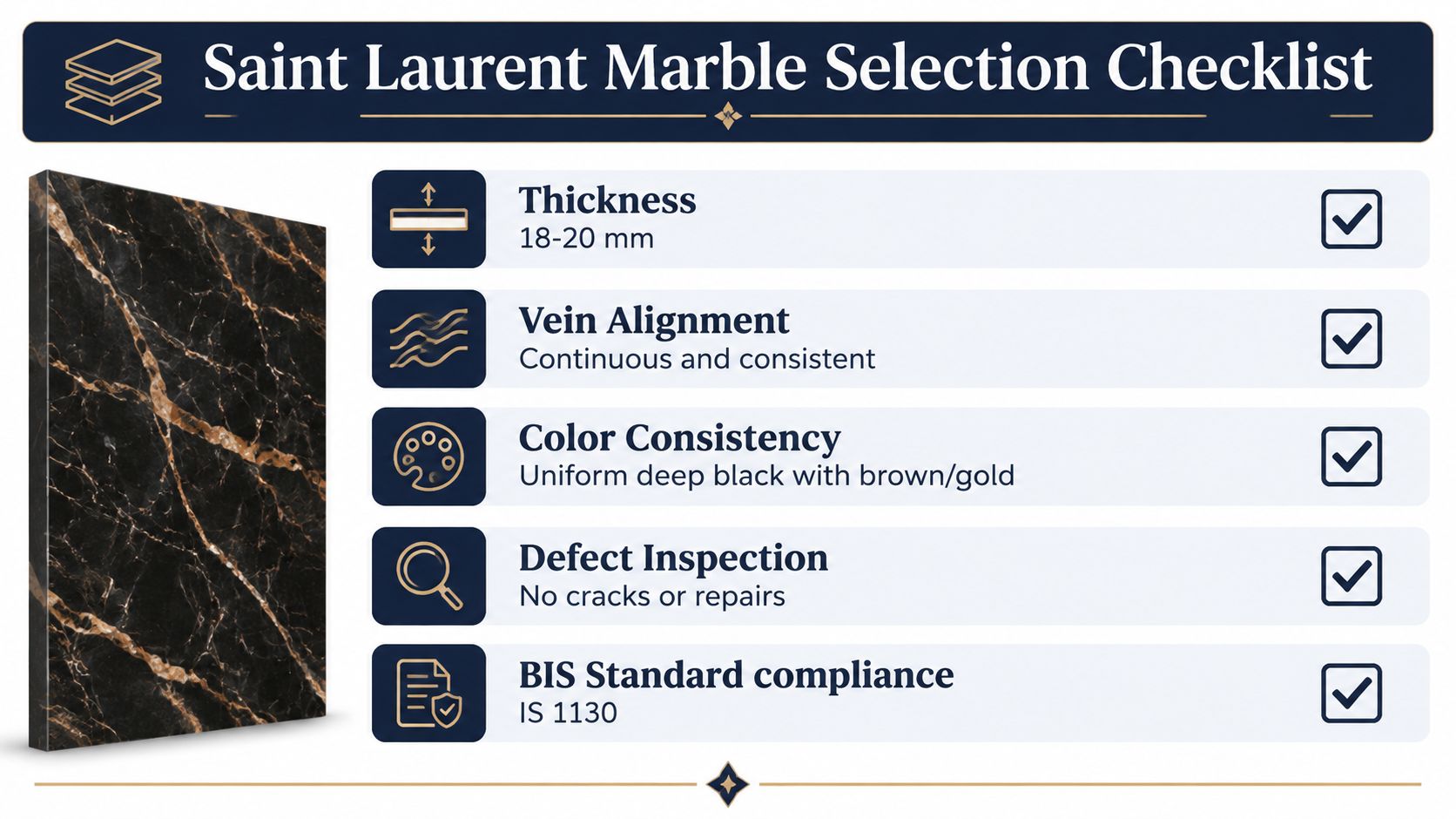
Confirm thickness. Indian listings position Saint Laurent marble at an 18.00 mm thickness specification (Indian Saint Laurent marble catalogue listing). Measure several points across each slab with a calibrated gauge. A nominal figure isn't enough if the slab varies materially from edge to centre.
Review the full face. Stand back and inspect the black field, then examine the surface at a low angle for waviness, resin patches, open fissures, edge damage, and visible repairs. BIS guidance says marble should be free from foreign inclusions and prominent cracks, a particularly important requirement for visible panels (BIS marble guidance.pdf)).
Approve the vein layout. Mark the intended wall, counter, or vanity pieces on photographs of the actual slab. Don't approve a generic “lot” and leave the fabricator to decide orientation.
Check the physical benchmarks. IS 1130 sets moisture absorption at no more than 0.4% by weight, a minimum Mohs hardness of 3, and a minimum specific gravity of 2.5 (IS 1130:1969 technical requirements). Ask for test documentation or arrange testing when the project specification requires formal acceptance.
Document acceptance. Record slab codes, measurements, photographs, repairs, finish, and the person approving the material. Attach the record to the purchase order.
For an additional perspective on selecting statement stones, see this resource on signature marble and granite. Use it as a selection aid, not as a replacement for physical inspection and BIS-based QA.
Pricing, Cost Factors, and Market Positioning
An Indian listing places Saint Laurent marble variants in a broad premium band of ₹350 to ₹900 per square foot (Saint Laurent marble price listing). Treat that as a material reference, not a finished project price. The final amount depends on slab selection, freight, handling, cutting, edge profiles, polishing, wastage, site access, fixing, sealing, and whether the supplier can fabricate from the approved slab.
Why showroom prices vary
Price dispersion usually reflects differences in the material, not just dealer margin. One lot may have stronger black tone, cleaner movement, better thickness consistency, and fewer repairs. Another may carry the same trade name but have weaker pattern continuity or a different origin claim. A quotation that doesn't identify the slab and scope of work makes comparison unreliable.
Wastage deserves special attention. A bookmatched wall, curved counter, or vanity with large cut-outs can leave unusable pieces even when the measured area appears modest. Ask the fabricator to prepare a slab nesting plan before you approve the order. Compare the usable output, not only the quoted slab rate.
Cost comparison
The brief provides a verified material range for Saint Laurent variants, but it doesn't provide verified slab, fabrication, installation, or total landed prices for local black stones. The table therefore shows what must be separated in a quotation rather than inventing unsupported amounts.
| Stone Type | Slab Cost (₹/sq ft) | Fabrication & Install (₹/sq ft) | Total Landed Cost (₹/sq ft) |
|---|---|---|---|
| Saint Laurent marble | ₹350–₹900 for listed variants | Obtain a project quotation | Calculate from slab, wastage, fabrication, and installation |
| Local black marble substitute | Confirm by lot and supplier | Obtain a project quotation | Calculate from slab, wastage, fabrication, and installation |
| Black granite substitute | Confirm by lot and supplier | Obtain a project quotation | Calculate from slab, wastage, fabrication, and installation |
A local substitute may reduce supply-chain uncertainty and simplify replacement, while Saint Laurent may justify its premium where the veining is central to the design. Make the decision by comparing approved slabs and complete installed scopes, not labels.
Fabrication, Installation, and Project Workflow
A Saint Laurent project can lose its visual value before installation if the approved vein direction is not carried through cutting, transport, and fixing. Treat the slab, drawing, fabrication, and site team as one workflow.
Approve the material before cutting
Begin with a measured site drawing and photographs of the actual approved slab. Mark sink cut-outs, hob openings, service penetrations, joints, returns, and exposed edges. For a feature wall, prepare an elevation showing each panel and the intended bookmatch. The architect or homeowner must approve this layout before sawing starts.
The fabricator should verify slab thickness, cutting direction, tooling, and the selected finish. Approve edge profiles with a physical sample whenever possible. A narrow polished edge creates a different visual weight from a laminated or rounded profile, especially against dark stone.
Record the slab code, face orientation, approved layout, and cutting plan. These records support supply-chain accountability and make it easier to compare the installed result with the selected material.
Control the hand-offs
Transport requires proper slab support, corner protection, and clear labels. Mark the approved face and orientation so the site crew cannot reverse the design. Before delivery, the installer should check wall flatness, substrate readiness, adhesive compatibility, joint positions, and access.
Use one accountable coordinator for fabrication and installation. A supplier that handles cut-to-size work, edge profiling, finishing, and installation coordination can reduce errors between vendors. Varun Marbles lists these services with imported and Indian marble categories and operates showrooms in Gurugram (Varun Marbles stone and fabrication services).
Site rule: Never allow an installer to choose a last-minute orientation for a prominent panel. Follow the approved slab layout.
Inspect lippage, joint alignment, edge finish, filled areas, adhesive marks, sealing, and cleaning at handover. Photograph the finished surface in natural and installed lighting. Keep the approval drawing and photographs with the project records, particularly where a local black-marble substitute could otherwise be compared only by colour rather than by vein continuity and total installed result.
Quick Reference Specifications and Standards
Use this table at tendering and slab acceptance. It separates published technical benchmarks from details that require direct supplier verification, which is essential when authenticating Saint Laurent marble in the Indian market.
| Item | Practical reference |
|---|---|
| Material category | Imported natural marble, commonly marketed as a premium black decorative stone |
| Listed thickness | 18.00 mm in an Indian Saint Laurent marble catalogue listing |
| BIS standard | IS 1130:1969, reaffirmed under the CED 6 stones committee in 2022 |
| Slab length | 70–250 cm under BIS guidance |
| Slab width | 30–100 cm under BIS guidance |
| Slab thickness range | 20–150 mm under BIS guidance |
| Moisture absorption | Maximum 0.4% by weight under IS 1130 |
| Mohs hardness | Minimum 3 under IS 1130 |
| Specific gravity | Minimum 2.5 under IS 1130 |
| Visual workmanship | No foreign inclusions or prominent cracks under BIS guidance |
| Verification contact | Supplier, importer, fabricator, and an appropriately equipped testing laboratory |
| Project records | Slab code, origin statement, measurements, photographs, test report, approved cutting layout |
Treat BIS dimensions as a fabrication and acceptance reference, not as proof of origin. They help confirm whether a proposed slab format fits Indian stonework practice, but they cannot establish that the material is genuine Saint Laurent.
For procurement, require the supplier and importer to record the quarry or origin statement, trade description, slab code, physical test results, photographs, and workmanship observations. Compare these records with the approved slab before cutting. This documentation also supports a fair total-cost comparison with local black-marble substitutes, whose lower purchase price may not reflect differences in pattern, fabrication, wastage, or installed finish.
Frequently Asked Questions
How can I distinguish Saint Laurent from a similar black marble?
Start with the complete slab, not a cropped sample. Look for the deep black base, the characteristic brown and gold movement, occasional lighter streaks, and a pattern that remains coherent across the slab. Then request the supplier's written origin and slab identification. A visual match without documentation is still an unverified match.
Is Saint Laurent suitable for a kitchen countertop?
It can be used for a kitchen counter when the owner accepts natural-marble maintenance and the fabricator handles cut-outs, edges, sealing, and support correctly. Acidic spills, abrasive cleaners, standing water, and rough use can affect the surface. If the priority is low maintenance rather than natural pattern, compare it directly with granite or engineered quartz before deciding.
Which finish should I choose?
Polished generally gives the strongest contrast and is well suited to feature walls and formal vanities. Honed is usually more restrained and can be more practical visually for floors. Leathered or brushed finishes add texture but need careful cleaning because dirt can collect in the surface profile.
What should I do if the seller claims the stone is imported but offers no records?
Don't pay an imported-stone premium on the claim alone. Ask for slab codes, origin information, purchase documentation, test records where required, and photographs of the exact slabs. If the supplier can't provide a usable trail, compare the material as an unverified black marble and obtain a second quotation.
Varun Marbles supplies imported and Indian marble, granite, quartz, and onyx, with slab selection, cut-to-size fabrication, edge profiling, and installation coordination available through its Gurugram operations. Visit Varun Marbles with your drawings and shortlist of applications, and ask the team to compare an approved Saint Laurent slab with suitable local alternatives on documented quality and complete installed scope.