
Neterwala Group of Companies Guide for Partners
You're reviewing a supplier list for a major project when the name Neterwala Group of Companies appears beside a specialised engineering or industrial requirement. The name sounds established, but a practical question follows quickly: what does the group do, and which company within it should a buyer or partner contact?
That question matters because a diversified industrial group isn't the same as a single-product supplier. Its public identity may cover metallurgy, precision manufacturing, environmental services, oil and gas instrumentation, engineering, and agriculture, while the contract, technical proposal, or invoice may come from a specific operating company.
Neterwala's history provides a useful starting point. The group traces its origin to 1956 in India, and its official company history describes its emergence during the early years of India's industrial development. Its own profile presents the business as having operated for over seven decades, while its LinkedIn presence identifies it as founded in 1956 and headquartered in Mumbai, Maharashtra, India. These details establish a long-running Indian industrial house, but they don't by themselves answer how the group is organised today.
This guide separates the legacy story from the operating structure. It explains how to interpret the group's specialist businesses, why public information can appear inconsistent, what the recent sustainability and energy repositioning may mean for Indian stakeholders, and which questions to ask before beginning a commercial relationship.
Table of Contents
- Introduction to Neterwala Group of Companies
- What Neterwala Group of Companies Actually Is
- How the Group Is Structured and How Big It Really Is
- Core Businesses and Industries the Group Serves
- Recent Rebrand and Shift Toward Energy and Sustainability
- What This Means for Stone and Construction Buyers and Partners
- Key Takeaways Before You Engage With the Group
Introduction to Neterwala Group of Companies
A buyer usually meets a corporate group through a specific task. An architect may see the name in a technical presentation. A contractor may encounter it in a vendor database. A procurement manager may receive a partnership proposal that refers to group capabilities across engineering, manufacturing, or environmental services.
The first instinct is often to search for a single company description. That approach can create confusion with a diversified house such as Neterwala. The group's public materials describe several specialist businesses, each serving a different industrial need. A company associated with alloy castings won't necessarily be the right contact for environmental monitoring, just as an oil field instrumentation business won't automatically handle a construction procurement brief.
The reliable starting point is the group's history. Neterwala traces its origin to 1956 in India, and the group describes itself as emerging during the early period of the country's industrial evolution. Its official profile also states that it has operated for over seven decades, which places the organisation in the category of long-established Indian industrial groups rather than a recently formed holding brand. See the official Neterwala company history for that background.
Why the name needs context
A long legacy can support confidence, but legacy isn't the same as project fit. Buyers still need to confirm the legal entity, technical team, manufacturing location, approval authority, and delivery responsibility attached to a proposal.
The group's broad public narrative creates both advantages and friction. Breadth may indicate access to deep industrial knowledge and several specialist capabilities. At the same time, outsiders can struggle to understand whether these businesses operate as one tightly integrated organisation or as a federation of companies connected by ownership, leadership, and shared values.
Practical rule: Treat the group name as an initial credibility signal, not as a substitute for entity-level due diligence.
That distinction is especially important for architects, contractors, industrial buyers, and potential partners. A useful review should ask three basic questions:
- Who will contract with us? Identify the exact operating company and registered entity.
- What capability is being offered? Match the proposal to a named business line, facility, or technical team.
- What evidence supports the claim? Request relevant credentials, project documentation, compliance records, and delivery references where appropriate.
The rest of the guide uses that practical lens. It presents Neterwala as a legacy industrial house with specialist businesses, then examines what its recent energy and sustainability messaging changes, and what remains to be verified.
What Neterwala Group of Companies Actually Is
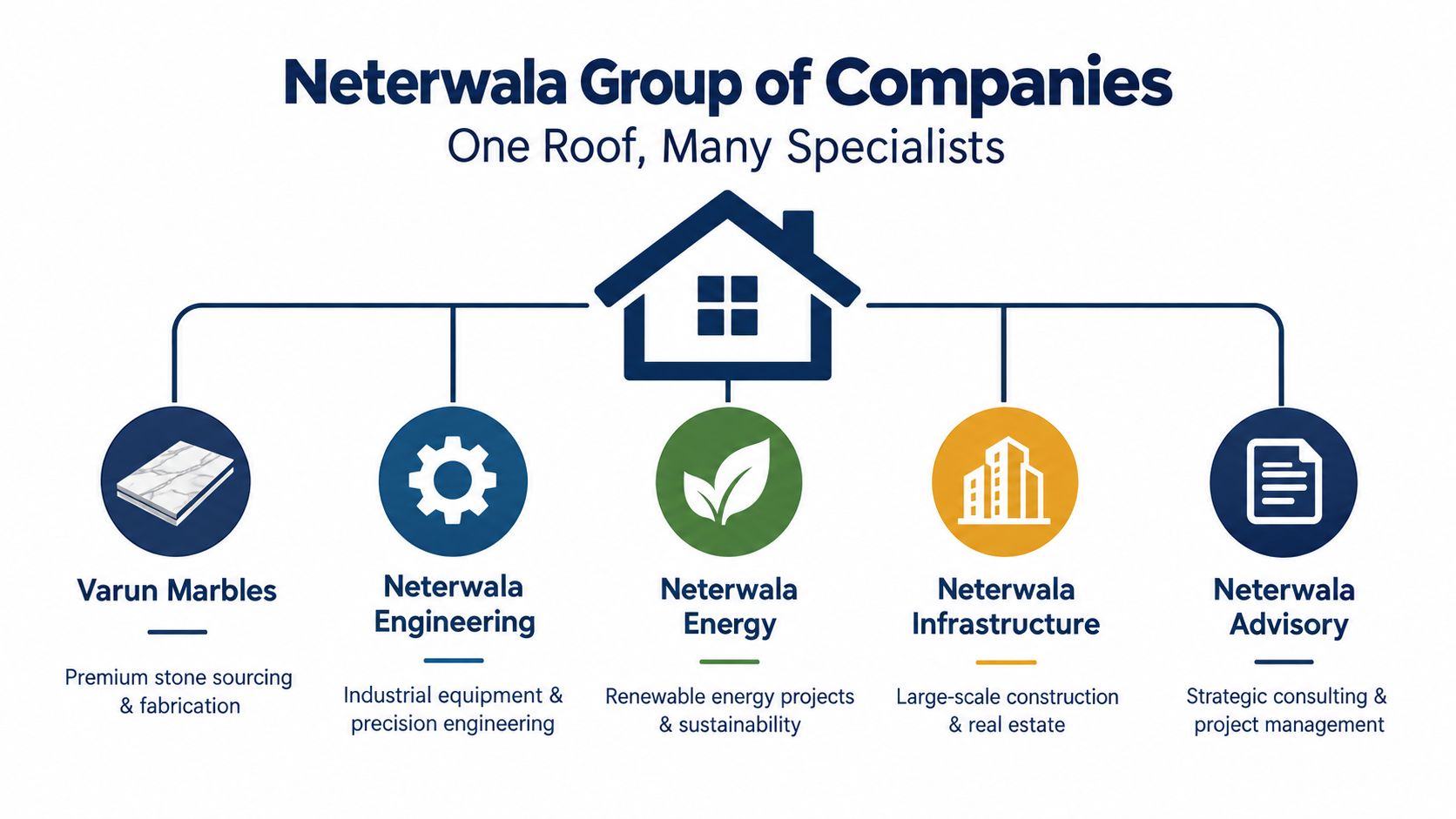
The simplest way to understand Neterwala is to picture a house with several specialist workshops under one roof. The house represents the group identity, leadership, history, and shared direction. Each workshop represents an operating business with its own products, customers, processes, and technical expertise.
That mental model is more useful than treating the group as one giant supplier. A diversified conglomerate may have a common ownership and strategic framework while its individual companies remain operationally distinct. One business might manufacture precision castings, another might deliver environmental services, and another might provide fluid control or oil field instrumentation.
A group is not automatically one integrated supplier
There are two common corporate models to distinguish.
The first is a single integrated company. It has one legal entity, one management system, and a central operating model. Its divisions may sell different products, but the customer usually knows which company owns the contract and delivers the work.
The second is a federation of specialist businesses. The parent or group brand creates an umbrella, while operating companies retain distinct expertise and responsibilities. Collaboration may exist, but a customer shouldn't assume that one division can automatically provide another division's service.
Public coverage describes Neterwala as a diversified Indian conglomerate with interests across metallurgy, aerospace precision casting and machining, environment, oil and gas mineralogy, engineering, and agriculture. Those areas are not variations of one product. They serve different industries, use different equipment, and require different forms of compliance and technical knowledge.
Why breadth creates confusion
Breadth can strengthen a group by spreading knowledge across industrial markets. Metallurgy may support understanding of materials, precision manufacturing may develop advanced production expertise, and environmental services may address monitoring or treatment requirements.
However, breadth also makes the buyer's job harder. A broad brand message can describe the family of businesses without showing which entity owns a particular capability. That's why the correct question isn't, “What does Neterwala do?” It's, “Which Neterwala business does this work, and how is that business equipped to deliver it?”
For partners, the distinction affects commercial discussions, technical specifications, warranties, reporting lines, and escalation routes. For jobseekers, it affects the role, location, and business unit they're evaluating. For industrial customers, it affects whether a proposal reflects an internal capability, a group referral, or an external partnership.
The group is therefore best approached as a legacy platform of specialist businesses. Its shared identity matters, but the operating company remains the most important unit for a real transaction.
How the Group Is Structured and How Big It Really Is
The most difficult part of researching Neterwala isn't finding a sector list. It's determining the exact relationship between the group brand, its operating companies, its locations, and its commercial scale.
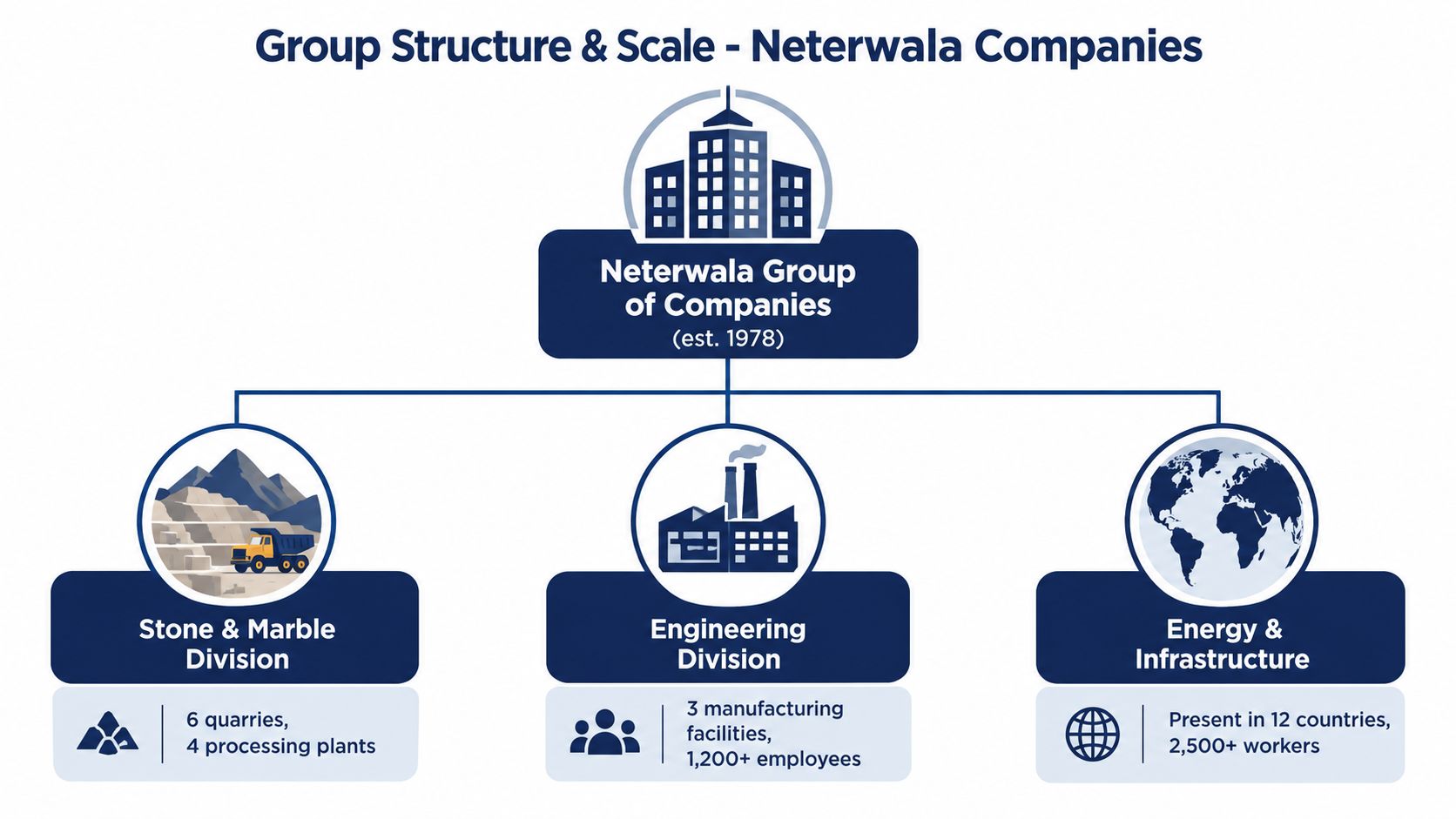
Public information offers a broad picture of a diversified Indian group headquartered in Mumbai, with activity extending beyond India. The group's own materials describe a professionally managed enterprise with operations and manufacturing presence across India, the United Kingdom, the Middle East and Gulf, and Asia Pacific. They also present several named businesses, including Uni Abex, Uni Deritend, Netel, Tritech, Uni Klinger, OFI, and Aquasoil, each associated with a distinct industrial or agricultural role.
At the same time, public coverage and external profile pages can provide inconsistent snapshots. Some directories list multiple subsidiaries and UK or Indian operations, while another source may show a very small employee count or frame a different legal entity. These discrepancies don't automatically prove anything negative. They may reflect differences between a parent company, a subsidiary, a local registration, a holding entity, or an outdated directory record.
Why public scale indicators conflict
A group's employee count can vary depending on whether the source counts one legal entity, a regional subsidiary, or the wider group. The same issue applies to revenue descriptions, manufacturing sites, headquarters, and ownership labels.
This is the central due diligence lesson: don't use a single directory profile as a complete group chart. Instead, compare the name on the proposal with the company's official website, legal documents, registrations, and the named contact's role.
A buyer should establish:
- The contracting entity: Confirm the full legal name, registered address, and authorised signatory.
- The operating location: Ask where the product is manufactured, tested, stored, or delivered.
- The business relationship: Clarify whether the group company is the supplier, parent, distributor, consultant, or referral partner.
- The decision path: Identify who approves technical changes, pricing, quality issues, and delivery commitments.
- The India connection: Verify which activities are performed in India and which are handled by overseas businesses.
A practical way to read the group narrative
The public narrative clearly supports the view that Neterwala is more than a single narrow industrial operation. Its history, named companies, and sector range point to a substantial multi-business structure. What remains less clear from public-facing material is how much integration exists between those businesses.
Do they share procurement, technology, sales channels, and project delivery? Or do they mainly operate as specialist companies connected through common ownership and group leadership? The available public information doesn't answer that question in enough detail for a buyer to assume one model.
That uncertainty matters when a proposal claims several group capabilities at once. A customer should ask for a responsibility matrix showing which company supplies each component, performs each service, and carries the relevant warranty or compliance obligation.
The fairest interpretation is that Neterwala has a broad, long-established platform, but commercial unit is still the specific operating company attached to the requirement.
Core Businesses and Industries the Group Serves
Neterwala's verticals make more sense when translated into the problems they solve. Metallurgy concerns the production and treatment of metals and alloys. Precision casting and machining turn engineered designs into components with controlled shapes, dimensions, and material performance. Environmental services help industrial operators measure, treat, and manage emissions, wastewater, and compliance needs.
The group's businesses also extend into oil and gas instrumentation, fluid control and sealing, and smart agriculture. These areas may sit under one group identity, but their buyer requirements differ sharply. A refinery, aerospace manufacturer, farm operator, and environmental compliance team won't evaluate suppliers using the same criteria.
| Business Vertical | What It Delivers | Typical Buyer or Partner |
|---|---|---|
| Metallurgy and alloy casting | Materials and cast components designed for heat, wear, corrosion, or industrial service | Steel, petrochemical, fertiliser, and process-industry companies |
| Aerospace precision casting and machining | Complex, high-integrity components manufactured to demanding specifications | Aerospace, defence, medical, and advanced engineering organisations |
| Environmental and analytical services | Monitoring, analysis, process support, treatment, and sustainability-related services | Industrial plants, infrastructure operators, and compliance teams |
| Oil and gas mineralogy and instrumentation | Field data, rig instrumentation, mud logging, analytics, and digital support | Oil and gas operators, drilling contractors, and service companies |
| Engineering and fluid control | Equipment and sealing solutions for safer and more efficient industrial systems | Process plants, utilities, and engineering contractors |
| Agriculture | Technology-led farming and produce initiatives with a sustainability focus | Agricultural partners, food businesses, and sustainability-oriented operators |
Matching the vertical to the requirement
A company seeking wear-resistant alloy components should begin with the metallurgy or casting businesses, not the group's general contact page. An aerospace buyer should request evidence of precision manufacturing, quality systems, machining capacity, and sector-specific approvals from the relevant operating company.
An environmental buyer may be looking for monitoring instruments, laboratory analysis, sewage treatment, biogas support, or ESG reporting. Those are related through sustainability, but they aren't interchangeable services. The technical scope should identify the exact deliverable, testing method, reporting responsibility, and site support included.
For a construction or interiors professional, the relevant comparison may be outside the group's core industrial verticals altogether. Material choice still requires its own technical evaluation. For instance, granite selections for demanding interior applications should be assessed by service conditions, finish, maintenance expectations, and installation requirements rather than by the reputation of an unrelated industrial brand.
Buyer perspective: A diversified group can open several doors, but you still need to enter through the door labelled for your actual requirement.
This mapping approach prevents a common mistake. Buyers sometimes assume that a group's broad engineering reputation guarantees competence in every adjacent category. It's safer to assess each proposal against the named company's equipment, people, quality controls, relevant experience, and contractual responsibility.
Recent Rebrand and Shift Toward Energy and Sustainability
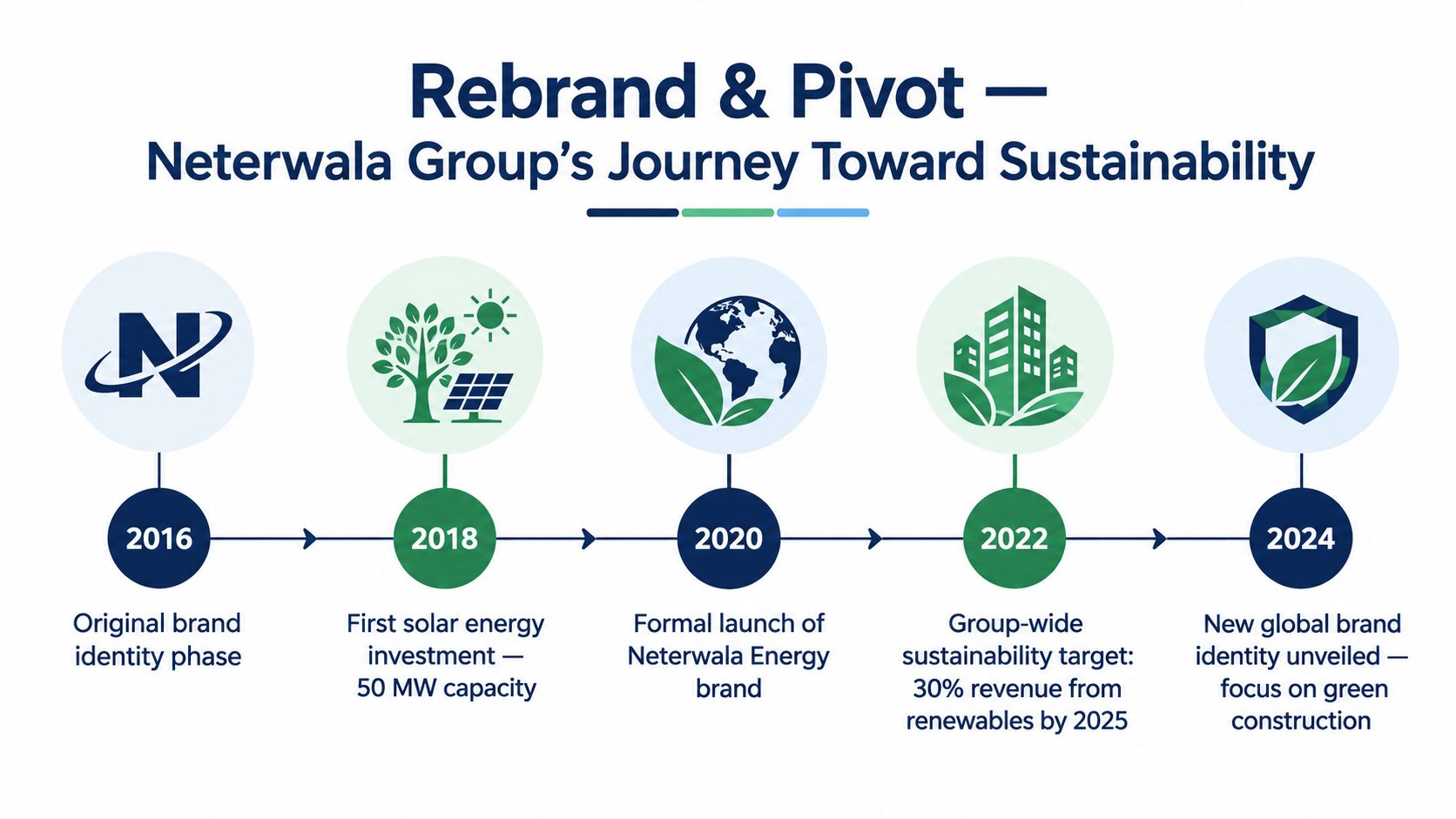
The recent repositioning adds a new layer to the Neterwala story. The group announced a refreshed brand identity linked to global growth, human-centric technology, environmental stewardship, and sustainability, while separate coverage highlighted integrated engineering solutions at India Energy Week 2026. These announcements suggest an effort to present the group not only as a legacy manufacturing organisation, but also as a participant in energy and environmental transformation.
That distinction matters because a rebrand can mean different things. It may clarify the relationship between existing businesses, communicate a new market ambition, or support a shift in investment and business development. It can also remain primarily a change in language, design, and positioning until customers can see corresponding projects, facilities, hiring, technology deployment, or revenue movement.
One press item reported that more than INR 320 crore of annual turnover came from the energy sector out of overall turnover exceeding INR 1,200 crore, as stated in the India Energy Week coverage of Neterwala's integrated engineering solutions. Those figures are press-reported claims, so a prospective partner should confirm their scope, accounting basis, period, and relationship to Indian operations before using them in a commercial assessment.
What Indian stakeholders should verify
The public material doesn't provide enough hard evidence to conclude whether the repositioning has produced a significant domestic project pipeline, new Indian capital expenditure, or a clear hiring expansion. That gap doesn't invalidate the strategy. It means buyers shouldn't confuse a compelling sustainability narrative with verified delivery capacity.
A serious evaluation should request:
- Project evidence: Identify completed or active Indian projects relevant to the proposed scope.
- Technical ownership: Establish which subsidiary performs the engineering, implementation, monitoring, or reporting.
- Environmental metrics: Ask what is measured, using which method, and over what reporting period.
- Commercial substance: Clarify whether the opportunity involves a product sale, long-term service, project development, or consulting engagement.
- Delivery commitments: Confirm timelines, local resources, maintenance arrangements, and escalation procedures.
Sustainability communication can also improve transparency during construction. For teams documenting site practices, progress, and environmental decisions, a resource on virtual tours for sustainable building may help explain how visual project records support stakeholder communication.
The sensible conclusion is balanced. Neterwala appears to be using its rebrand to connect industrial engineering with energy and sustainability. Indian buyers should welcome the clearer direction, but test it through entity-level evidence, measurable scope, and project-specific accountability.
What This Means for Stone and Construction Buyers and Partners
A stone buyer may encounter Neterwala while researching a wider construction or engineering ecosystem, but that doesn't mean the group should be treated as a direct substitute for a specialist stone supplier. The connection is more practical than categorical. Construction projects often combine material sourcing, engineering coordination, environmental obligations, fabrication, installation, and facility performance.
Consider an architect specifying a worktop for a hospitality project. The decision may involve appearance, stain resistance, water exposure, fabrication tolerances, edge details, installation sequencing, and maintenance. A broad industrial group may be relevant to building systems or engineering coordination, while the stone decision still belongs with a supplier that understands slabs, finishes, cutting, and site installation.

Material performance comes before brand familiarity
For natural stone in India, water absorption and porosity are among the most useful technical discriminators. BIS-linked methods such as IS 1124 help compare how marble and granite respond to moisture and staining conditions. India-focused technical guidance gives indicative water absorption ranges of about 0.1–0.5% for granite and 0.2–0.6% for marble, as reported in this India-focused guide to natural stone standards.
Those ranges are indicative, not a replacement for testing the selected material. Granite is generally denser and less porous than many marbles, which helps explain its common use in high-traffic floors and moisture-exposed worktops. Marble can deliver a distinctive appearance, but it usually requires more disciplined sealing, cleaning, and maintenance.
Engineered quartz creates a different operational issue. Quartz and silica processing carry a recognised occupational hazard, and the Indian Minerals Yearbook identifies a potential threat of silicosis for workers handling quartz, silica sand, and gravel. The Indian Minerals Yearbook material on quartz and silica supports a clear specification principle: dust control should be designed into fabrication through methods such as wet cutting, suitable respiratory protection, and exposure reduction.
Three practical project situations
A residential renovation needs a material that suits the homeowner's cooking habits, cleaning routine, budget, and visual preference. The selection conversation should cover slab characteristics and maintenance, not just colour.
A commercial fit-out needs repeatability. The buyer should confirm batch consistency, approved samples, cut lists, edge profiles, installation sequencing, and responsibility for damage or variation.
A large construction partnership needs interface control. If several specialist businesses participate, the contract should identify who owns design coordination, procurement, testing, site safety, commissioning, and post-installation support.
A practical guide to kitchen marble and granite can help buyers frame those material questions before they compare suppliers. The broader lesson is simple: a respected conglomerate may be an important engineering or infrastructure partner, but stone buyers still need stone-specific inspection, fabrication, and installation expertise.
Key Takeaways Before You Engage With the Group
Neterwala is best understood as a long-running Indian industrial group with a federation-style profile, not as one undifferentiated supplier. Its origin dates to 1956, and its own history presents a legacy spanning over seven decades. The group's range covers metallurgy, precision casting and machining, environmental services, oil and gas instrumentation, engineering, and agriculture.
The recent brand refresh and energy messaging point towards a stronger emphasis on sustainability, international growth, and integrated engineering. They also create a responsibility for buyers to separate strategic language from evidence tied to a specific Indian project, subsidiary, facility, or contract.
Before engaging, use this checklist:
- Verify the entity: Match the proposal, contract, bank details, and authorised signatory to the correct operating company.
- Define the scope: Write down exactly what will be designed, manufactured, supplied, installed, monitored, or maintained.
- Confirm location: Establish where production, testing, engineering support, and project management will occur.
- Request proof: Review relevant credentials, quality documentation, references, and environmental records.
- Test sustainability claims: Ask for metrics, methods, reporting periods, and project-level outcomes rather than relying on broad messaging.
- Clarify interfaces: If multiple group companies are involved, assign responsibility for delivery, warranties, safety, and escalation.
Engaging the group may make sense for complex industrial, engineering, environmental, or energy requirements that need specialist capabilities. For a stone-led interior or construction requirement, a focused supplier with direct material knowledge, slab inspection, fabrication, and installation coordination may be the more direct route. If your project needs a specific stone partner in the NCR, use the Varun Marbles contact page to begin a focused discussion.
Varun Marbles helps architects, homeowners, builders, and fit-out teams compare engineered quartz, Indian and Italian marble, granite, and onyx with support from selection through fabrication and installation. Visit Varun Marbles to review stone options and discuss the right material for your project.